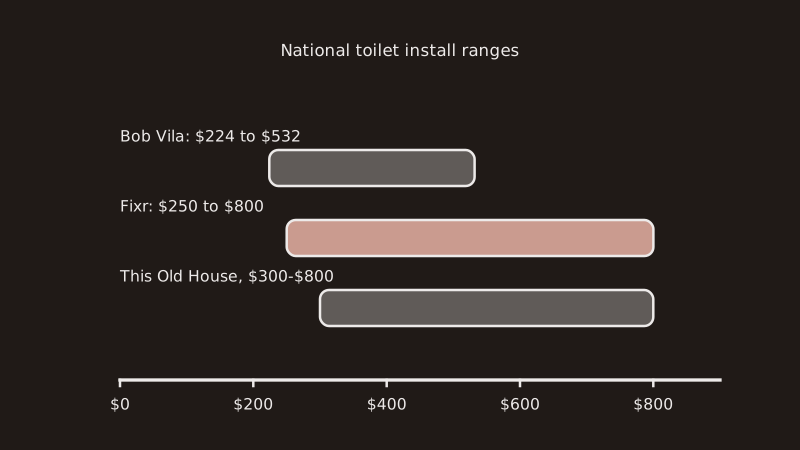
One national guide, Bob Vila, lists toilet installation at $224 to $532, with $372 as the average (checked 2026-11-17). Treat that as a rough anchor only, since the figure on the written quote is the one you pay. Bob Vila gives it as a total installation range, so look at what a quote counts inside it. Everything about toilet work sits on our toilet plumbing page; to arrange a visit, use the quote form. Other jobs are on the home page.
What does installing a toilet usually run?
Three guides give three ranges: Bob Vila at $224 to $532 (average $372), Fixr at $250 to $800 (average $450), and This Old House at $300 to $800 in its job table, all checked 2026-11-17. They are national, not San Bernardino or Redlands figures. Your own number arrives with the paper quote.
The spread exists because each source mixes different jobs, from a plain swap onto a sound flange to installs that add a new shutoff valve. Read a range as the usual territory, not a promise, and ask what the number covers whenever a quote falls outside it.
| Source | Range | Average |
|---|---|---|
| Bob Vila, toilet installation | $224 to $532 | $372 |
| Fixr, toilet installation | $250 to $800 | $450 |
| This Old House, toilet installation | $300 to $800 | not stated |
Hourly rates play in as well: This Old House reports plumbing labor anywhere between $25 and $200 an hour, reflecting region and experience.
Does tearing out the old toilet change the price?
Not usually; pulling the old one is part of the same visit as setting the new one, so the ranges above already assume it. The plumber closes the supply, empties the bowl, lifts it off, cleans away the old wax, inspects the floor flange, sets the new bowl on a fresh seal, hooks up the supply and flushes to test. Carting off the old porcelain may be a line item.
Extras that raise a quote beyond a basic swap:
- A new shutoff valve or braided supply, where the old ones are crusted or will not turn.
- A cracked flange, or one that now sits below new flooring.
- Soft or rotted subfloor around the base, discovered after the lift.
- Hauling the old bowl away.
- A different rough-in distance, which changes where the new toilet can sit.
Older housing is where surprises under a toilet turn up. Del Rosa, ZIP 92404, shows a median build year of 1963 in Census data, and floors and flanges of that age may have taken decades of slow seepage. A plumber who finds soft flooring or a rusted flange should say so before going on.
Is the quote you were given fair?
Set it beside the ranges above, then see what is bundled. Expect to pay more with a damaged flange, a shutoff that fails, or toilet supply by the plumber. A bid well beyond $800 for an ordinary swap deserves a question about inclusions. A bid far below $224 deserves one too, since something may be missing.
Points to settle on paper:
- Who buys the toilet, and what does the total cover?
- Are the wax seal, bolts and supply hose part of the price?
- How are a damaged floor or flange handled?
- Is hauling away the old unit included?
- The contractor license number, which state law requires from $1,000 of labor and materials upward or on any permit job.
A plain like-for-like swap seldom hits $1,000. If the work reaches into drain piping or shifts any plumbing, have the plumber say whether a permit applies.
How is labor priced for a toilet swap?
The guides above give installation totals with no separate labor line, and we found no verified local labor rate. Labor of $75 to $150 an hour appears on Fixr's unclogging page, and This Old House shows a national spread of $25 to $200. A swap is a short visit, so labor is a modest slice of the total.
Time depends on access. A roomy bathroom with a sound shutoff is the fast case. A bowl tucked against a wall, or a valve that is stuck, stretches the visit, and some plumbers charge a minimum for coming out.
And if the toilet is only clogged?
Fixr prices unclogging between $200 and $700, averaging $350 (checked 2026-11-17). For general drain clearing, This Old House gives $100 to $500. Both are separate from replacement. Details are on the unclog cost page, and the clogged toilet guide helps before you pay.
A bowl that clogs again right after a plunge sometimes argues for a new one, especially an old model. Whether the trouble lives in the bowl or the drain behind it is something a visit settles.
How do you swap a toilet handle on your own?
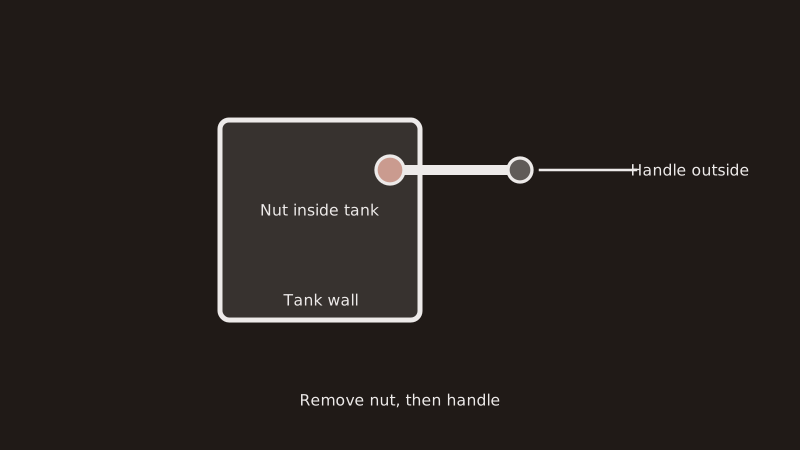
A side-mount handle swap is a ten-minute task. Turn off the supply, flush the tank dry, take off the lid, and unscrew the nut that holds the handle from within. Many of these nuts are reverse threaded, so try clockwise first. Pull the old handle through, seat the new one, and clip the chain back on.
When the handle keeps failing or the flush stays weak, the fault usually sits inside the tank instead. See a running toilet and the fill valve for those. Seepage around the base is another matter, handled in toilet leak help.
Would a handyman cost less than a plumber?
Possibly, but no verified local handyman price turned up. A straight swap is within a handyman's reach, though the state's contractor license rule still bites on bigger bills and permit jobs. Where plumbing experience pays off is a bad discovery underneath, such as a broken flange, so ask who deals with that.
Common questions
How long does swapping a toilet take?
A basic swap often takes a couple of hours at the house, though we have no verified local figure and every home differs. A stuck valve, broken flange or soft floor adds time. Ask for an arrival window at booking, and ask what could lengthen the visit.
What belongs in the written quote?
It should list the bowl, wax seal, supply line, shutoff valve and removal of the old unit. Ask who deals with a damaged flange or floor, and how long the visit runs. The contractor license number can then be searched on the state board's website.
Is someone required on site during the swap?
An adult should open the door and be reachable to approve extras, such as a flange repair found when the bowl comes up. Many people stay in and clear the bathroom beforehand. If you cannot, name a person the plumber can phone to approve changes, and be sure the water can be shut off.