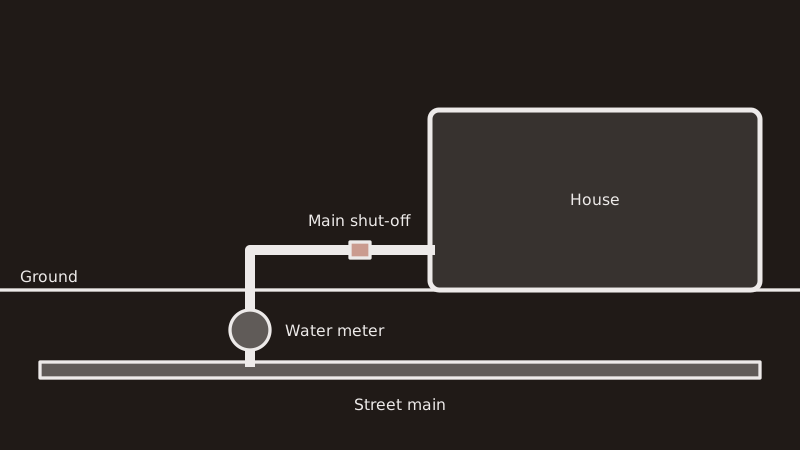
Close the main. That is step one, and it beats everything else on this page. Once the water has stopped, pick up the header phone or fill the quote form and we begin lining up a plumber near your address in San Bernardino, Redlands, Highland or Yucaipa. Slow seeps belong on leaks and burst pipes. Home lists everything else.
Where is the shut-off, and what comes after it?
Spin the main valve clockwise until it bottoms out. A hose spigot or ground-floor faucet, opened afterward, empties whatever is still in the pipes. Kill the water heater at the breaker. Snap pictures of the soaked area before anything moves, then call. Shutting the valve is what limits damage, so it goes ahead of the phone.
Look on the front wall near the spigot first, then under a small lid by the street. Old gate valves freeze in place. When yours will not turn, quit leaning on it: a snapped stem is worse than a stuck one. Mention it when you phone.
Do not mix wet hands, wet floors and the breaker box. A light fixture sagging with water, or a puddle around the panel, means you stay back and keep the household away. 911 is the call if anyone could be shocked.
Rotten eggs in the air change the plan. Everybody leaves the building. Telephone SoCalGas from the pavement at 1-800-427-2200, and fall back on 911 if the call goes unanswered.
Are burst pipes common?
No trustworthy tally exists for San Bernardino or Redlands, so none is quoted here. The closest firm figure is national: the EPA's yardstick for the average home is a loss of over 9,300 gallons a year. A burst is the dramatic end of that spectrum.
The causes are a short list. Corrosion is a common one. ZIP 92404, which covers Del Rosa, has a Census median build year of 1963 and 5,936 homes from the 1950s. Houses of that vintage can carry galvanized steel that corrodes from within, or early copper that has thinned. After age come water pressure set too high, a poorly soldered joint, a root pressing on a yard line and, occasionally, ice.
Living with 60-year-old pipes means a failure is a matter of timing. The repipe cost page shows what swapping them involves.
What actually happens when a pipe goes?
Water keeps coming until the supply is closed. A split in a half-inch line can fill a bucket in minutes, wetting drywall, insulation and flooring as it goes. Soggy materials invite mold, so drying the house matters nearly as much as repairing the pipe.
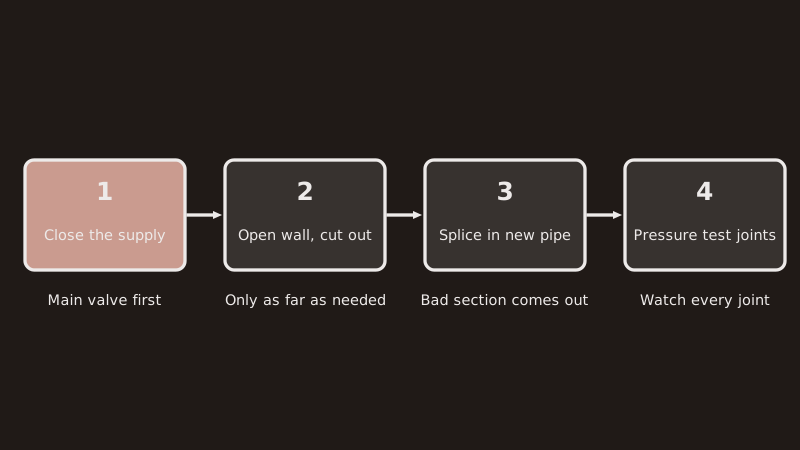
With the supply closed, the repair goes in this order:
- The plumber traces the failed stretch and opens the wall or ceiling only as far as needed.
- The bad section comes out. A new length goes in, or the whole run is rerouted when the pipe has gone thin in several places.
- Pressure goes back on, and the plumber watches every joint.
- Wet drywall and carpet get removed. That part falls to you or a drying contractor, not the plumber.
Concealed breaks give other clues. Listen for hissing behind drywall, watch the meter dial creep while every tap is closed, feel for warm floor patches, and look for a brown halo spreading overhead. The wall-specific checks live in spotting a burst pipe. Water under a concrete floor is its own subject, priced at slab leak repair cost.
Does cold weather matter here?
Ice takes more room than water, and a pipe gives way when the ice has nowhere left to push. No single temperature applies, because wind, insulation and the length of the cold spell all shift the answer. The exposed lines in attics, garages, crawl spaces and on outer walls go first in a hard freeze.
Here, age and pressure do more harm than frost. When a freeze is forecast anyway, leave a tap dripping, prop open the cabinets under outside-wall sinks, and unscrew hoses from the spigots.
One trap: a split pipe can stay sealed by ice until it thaws. Water that appears on a warming afternoon should be treated as a burst.
What if it happens in an apartment, a basement or a bathroom?
The shut-off logic holds, but who controls the valve and where the water lands differ. Tenants should message the property manager immediately and ask for the building valve to be closed. Basements collect water, so no one stands in it while anything is powered. In a bathroom, the stop valve beneath the fixture may end the flow faster than the main.
Apartments bring a second headache, because water drops through floors. Knock on the unit below and photograph everything. Condo owners should find out whether the HOA owns the pipe inside the wall before anyone pays a bill.
Basement photos should show the waterline on the wall and any stored boxes. For wet ceilings under a bathroom, the checklist in ceiling water leak picks up from here.
Does a yard or sprinkler pipe work differently?
Close the irrigation valve if you can find it, and the house main if you cannot. A jet at a sprinkler head usually means a fitting got clipped by a mower or tire. A soggy patch of lawn with no head nearby suggests a buried pipe has let go. Mark the spot with a flag so the plumber digs in the right place.
Hard pressure wears out every joint downstream. Under CPC 608.2 the ceiling at fixtures is 80 psi. A hardware-store gauge on an outdoor spigot reveals your reading, and adjusting a pressure regulator valve explains the follow-up.
The run between meter and house is contractor work, and a permit often comes with it. San Bernardino city residents can ask Building and Safety on 909-998-2000.
What does a rush visit run?
A bill has three parts: the visit fee, the labor and the parts, plus extra for nights and weekends. Bob Vila quotes $100 to $350 for the visit and $45 to $200 hourly for labor, while emergency hours can run from 1.5 times that rate to triple it. Slab leaks, tougher to reach, run $630 to $4,400 in its slab leak guide. These are national guides.
The final number arrives in the written quote, not here. Two things move the total. Timing is the first: a Sunday-night arrival costs more than a Tuesday-morning one. Reach is the second. A split below a kitchen sink is quick; the identical split buried in plaster or concrete adds cutting and patching.
That same page adds that a flat extra of $100 to $350 may sit above the hourly figure for after-hours calls. Before the meter starts running, ask for visit charge, hourly rate and any minimum in writing. Keep receipts for the insurer and argue coverage later.
Whose bill is the damage?
The location of the pipe and the name on the title settle it. Owners generally carry anything after the meter, and a homeowner policy might respond to a sudden break. Tenants should email or text the landlord that day so a record exists. Condo HOA documents divide duties between the association and the unit.
Insurers separate a sudden burst from a drip nobody noticed for months. Skim the policy or call the agent while the plumber is still there and ask what evidence is wanted. Photos, the invoice and a note on what failed generally cover it.
Street pipes are normally the water utility's concern, and where that ends depends on the meter. Your bill shows who serves you: SBMWD, East Valley Water District, Muscoy Mutual, the City of Redlands or Yucaipa Valley Water District. Before the meter, call them. After it, call a plumber.
A contractor license is mandatory in this state for work that adds up to $1,000 with parts, and for anything under permit. To check one, use the lookup on the state board's website.
Common questions
How quickly does someone show up?
That turns on how many calls are queued, and we promise no clock time. After arrival, a plain exposed line can wrap up within hours. A split in a wall or slab might need a return trip to open, mend and close. Before work begins, request the plumber's own time estimate.
What do I ask when the plumber calls back?
Four items: the visit fee, the hourly figure, whether nights or weekends add a surcharge, and whether a written quote comes first. Then request the contractor license number, find out who applies for a permit if one is due, and learn whether the repair is a stopgap or final. Jot it all down.
Do I have to wait at the house?
Early on, yes: someone must show the leak, approve the price and open the way to the shut-off. Later a trusted adult can take over. Renters should tell the landlord, since the unit may need unlocking. Someone also has to be reachable by phone, so the plumber can agree the price before a wall is opened.
Is a clamp a real fix?
A band clamp or slip coupling can hold a split shut while you wait, but that is borrowed time. Damage keeps growing behind a patched line, and tired pipe tends to fail a second time. The plumber should cut out the bad stretch and inspect its neighbors.