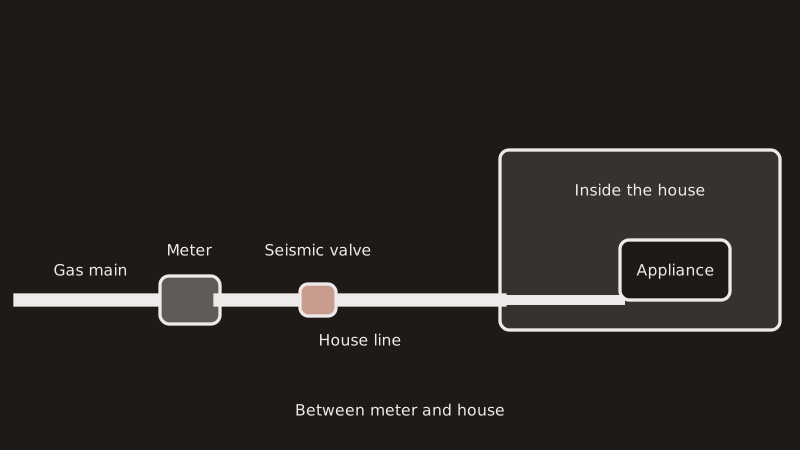
Picture a spring-loaded or ball-driven device clamped onto the gas pipe at your house. Strong ground motion trips it, the pipe closes, and gas stops entering the building. SoCalGas says it belongs on the customer's own house line and that a qualified professional can fit it. A local plumber does that job, and we arrange it. For gas work in general, see the gas line service page; other work is on the home page.
What is this valve supposed to accomplish?
SoCalGas calls it a valve that "automatically shuts off your natural gas service when an earthquake of a sufficient magnitude occurs at your home." Its purpose is simple: after a quake, a torn appliance connector or a pipe knocked out of line can vent gas while everyone is asleep, away or hurt. The valve cuts the supply without anyone having to act.
Shaking triggers it, not a smell, so a worn connector that seeps gas on a still afternoon goes unnoticed. Neither does it replace an appliance shutoff that works or a gas detector. Think of it as a single layer in a larger plan. Searchers on this subject frequently mention the Northridge quake of January 1994. Whether your home is obliged to have one can hinge on the local building division and on rules tied to a sale or a large remodel. We cannot check every address here, so ask the building office before assuming anything.
Where on the property does it belong, and can it go on the meter?
On the house line, which is the stretch of pipe from the meter to your building. SoCalGas says earthquake valves are not permitted in its curb meter vaults and must go on your house line, not on its facilities. The utility side is no place for customer-owned equipment.
That answers anyone searching for a "gas meter earthquake shut off valve": nothing gets attached to the meter or the utility's piping. SoCalGas owns its meter and its own facilities. Your house line is yours, and a plumber installs the valve there; ask SoCalGas where its equipment ends if you are unsure.
According to SoCalGas, it does not install earthquake valves for customers. Operating its shutoff at the meter is reserved for SoCalGas or contractors it has approved. If gas has to be stopped in an emergency, do not wrestle with that fitting.
Is an excess flow valve the same thing?
No. An excess flow valve sits underground on the service pipe that connects the main to the meter, throttling flow if that pipe is damaged. SoCalGas notes it "does not shut off the flow of natural gas completely." An earthquake valve answers to shaking and sits on the house line.
This matters while shopping. Product listings that say "automatic gas shut off valve earthquake" or an "earthquake actuated" device describe the house-line type. An excess flow valve counts as utility equipment, and buying one will not protect your indoor piping.
How do I choose among the models?
The sources we read do not rank brands, so we name no favorite. Have the plumber state the model, confirm California approval, and check with your building division about any list of accepted models. Look for clear reset instructions and a size that fits your house line.
Questions worth asking:
- At what point on the house line will it sit, and is that spot dry and within reach?
- Does the model match the pipe size and the gas demand?
- Who files for the permit, in case one applies?
- How is it reset, and whom do I call when it trips?
What happens after the valve closes in a quake?
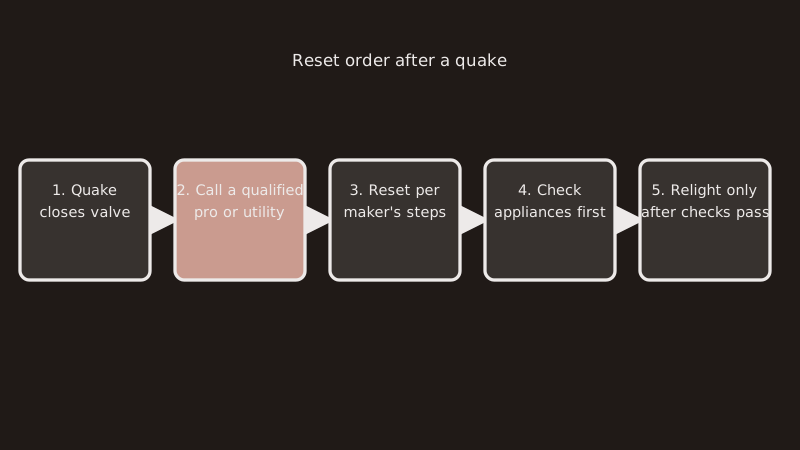
Manufacturers supply reset instructions, SoCalGas acknowledges, but it recommends a qualified professional or SoCalGas handle the reset, with appliances checked before anyone restarts them. After a major emergency, reset help may be slow, so do not count on a same-day visit.
Gas odor, or any hint of a leak? Step outside before anything else. From there, ring SoCalGas at 1-800-427-2200, and 911 if you cannot get through or someone faces danger. Leave switches, flames and the hunt for the source alone. SoCalGas adds that a fee applies when it resets a valve or relights pilot lights after the valve closed for any reason other than an earthquake.
Which office handles the permit and inspection?
In California gas piping is generally contractor work, and the license law reaches every job requiring a permit. Whether a seismic valve needs one in your town is for the building office to say. San Bernardino County lists plumbing permits for work on existing buildings, and Muscoy, Mentone and other unincorporated areas deal with its Building and Safety office at (909) 387-8311.
Inside the city of San Bernardino, call Building and Safety at 909-998-2000. Redlands publishes 909-798-7536, Highland 909-864-6861 ext. 232 and Yucaipa 909-797-2489. SoCalGas's cities list covers San Bernardino, Del Rosa, Patton, Muscoy, Highland, Redlands, Crafton, Mentone and Yucaipa, while Oak Glen is missing from it, so verify gas service there before planning. Our gas line cost page explains pricing for gas work, and the permits and codes page covers permit questions. Your local area office can settle the rest better than a guess.
Someone at the door claiming SoCalGas requires or pays for a valve deserves a check on socalgas.com first. No earthquake valve price was verified for this page, so the cost appears on the written quote.
Common questions
Does the installation take long?
Often little, because the valve threads onto an exposed section of the house line. The plumber still has to stop the gas, fit the valve, test for leaks and relight appliances, and access, pipe condition or a permit can lengthen the visit. The written quote, not a phone call, carries the time estimate.
Could I put it in myself?
No. A mistake with gas piping means a leak, and gas piping is generally contractor work in California. SoCalGas says to bring in a qualified professional for a valve on your house line. The legal line for homeowners is clear: hand gas fittings to a contractor who holds the proper license.
What do I verify before picking a plumber?
Get the model and its location, whether a permit applies, how it resets, and what the whole price covers. Request the contractor license number and confirm it on cslb.ca.gov ahead of accepting the quote. Ask who pulls the permit, if one applies, and whether the written quote names the valve model so you can compare offers line by line.
Does the valve cure a gas smell?
No. Strong shaking trips it, a hissing pipe on a calm day does not. If gas is in the air, head outdoors and call 1-800-427-2200, or 911 if anyone is in danger. The quote page serves planned work, not emergencies.