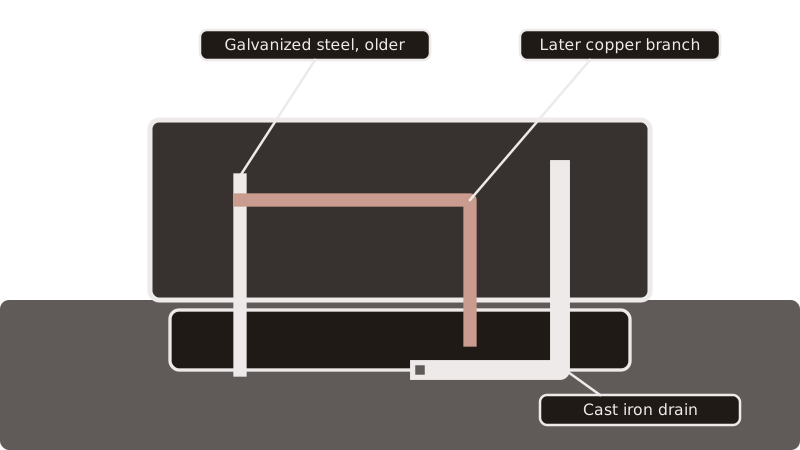
Redlands was incorporated in 1888, and the blocks near downtown still show it. If your home was built before the 1950s, the plumbing inside the walls may be original or a patched mix of eras, and that is where most of the work in this part of town comes from. Our job is to get a nearby plumber out to inspect it and a written price. See all the areas we cover for the wider region.
Why do old Redlands houses need different plumbing work?
Because the house and the pipes rarely share the same age. In the ZIP code that covers downtown, 92373, the Census counts 1,372 homes built before 1940 and another 492 from the 1940s, out of 14,468 homes in total. Homes from those decades were commonly plumbed in galvanized steel with cast iron drains, and a later owner may have swapped a bathroom or kitchen into copper.
That patchwork is the real issue. A repair at one fitting can expose a section that crumbles when touched, so the plumber often has to decide on the spot whether to patch or to replace a run. Rust-brown water at a tap, a drop in pressure that gets worse over a few years, and small leaks at threaded joints are the usual signs of aging steel. The options are laid out in our galvanized pipe replacement guide.
What is Downtown Redlands built on?
Citrus. E. J. Waite planted the first orange grove here in 1882, and for close to 75 years the town led the world in navel oranges, with more than 15,000 acres of groves by the late 1930s. Streets laid out for grove owners' houses carry a good number of large, early homes on generous lots, so expect a longer reach from meter to kitchen sink than a compact modern tract has.
The A.K. Smiley Library (1898) and Kimberly Crest (1897) anchor the historic area nearby. If your house sits inside a historic district, ask the City about any rules before you plan visible exterior changes. Hidden plumbing inside the walls is a different matter, but it is worth asking before work starts.
What is the water like downtown?
The City of Redlands Municipal Utilities and Engineering Department supplies drinking water to Redlands and the Mentone area. Its 2026 water quality report says about half of the supply is treated surface water and the other half comes from 18 local wells in the Bunker Hill Groundwater Basin. The bill will name your supplier if yours is an unusual address.
For hardness, the report lists 148 mg/L in the groundwater (range 100 to 200) and 117 mg/L in the surface water (range 94 to 140). Converted, that is roughly 8.7 and 6.8 grains per gallon. Expect chalky buildup on faucets and inside a tank heater as the years pass. If it bothers you, water softener installation is the page to read.
What does a permit involve for work in Redlands?
Redlands keeps its permit staff in a One Stop Permit Center, 35 Cajon Street, Suite 15A, run by Building and Safety. The City lists water heaters among the over-the-counter permits applied for through its online portal, with payment made in person before the permit is issued. Counter hours are 8:00 am to 4:30 pm Monday through Thursday, and it is closed alternate Fridays.
For a repipe the City's page gives no separate steps, so ring 909-798-7536 ahead of a bigger job and ask. California wants a contractor holding a state license on any permitted job and on work from $1,000 up; you can check one at cslb.ca.gov.
What does a repipe cost in a historic home?
Bob Vila's guide, checked 2026-11-17, quotes a spread of $1,500 to $15,000 for a whole-house repipe, with $7,500 as the national average. Big older houses with two bathrooms and plaster walls land near the top, since extra plaster must be cut and patched. The written quote fixes the real figure, so check that it names what is replaced and what wall repair is included.
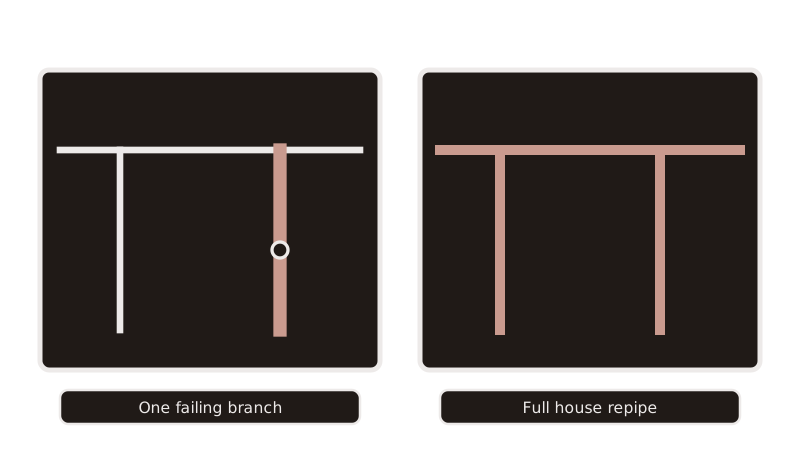
A repipe is not always the answer. If only one branch is failing, a smaller job may buy you years. If you cannot tell which it is, the visit exists to answer that. Our repipe cost page explains what pushes the number up and down.
Ready to ask for a visit?
Try the quote page. Describe what you see, how old the house is, any pipe changed before. A picture of the heater and main shutoff helps the plumber come prepared. Someone from a local plumbing business visits, looks around and writes the quote before any work begins.
Common questions
Is a single patch realistic in a house this old?
Often. If the remaining pipe is sound, one repair costs less and finishes sooner. With the leak exposed, the plumber ought to examine what sits either side, because worn steel can fail again close by. Get that finding in writing so a patch and a repipe can be priced against each other.
Who applies for the heater permit?
Yes, the City lists water heaters among its over-the-counter permits, requested through the online portal. The City's page is thin on detail, so confirm the process with the division on 909-798-7536 before booking, and expect the permit to be applied for by the contractor.
Do historic districts add rules for plumbing?
The listed districts around the Smiley Library and Kimberly Crest may carry their own rules for exterior changes, and none have been checked for this page. Pipes inside walls are rarely visible, but a new vent or exterior line could be. Ask the City before work, and mention the district to the plumber.
Every area we cover is listed on plumber across San Bernardino.