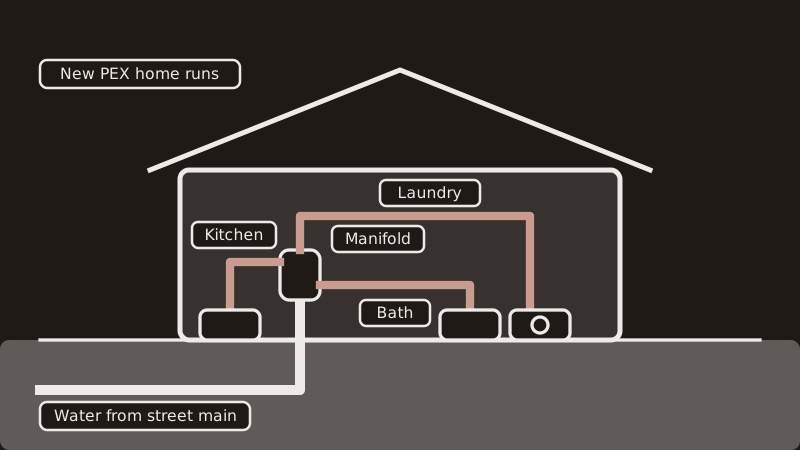
Behind your drywall, a network of supply pipes feeds every faucet, shower and appliance. Repiping retires that whole network and installs new tubing in its place. We arrange the visit and put the quote in writing, and a local plumbing business does the work. One national guide describes a wide band for a typical job, $1,500 at the bottom and $15,000 at the top, and the quote narrows it. Begin a visit on the quote form, and browse our other services from the home page.
What does repiping a house involve?
A repipe retires the tubing feeding faucets, showers, toilets and appliances. A plumber cuts into walls and ceilings at selected spots, draws out the old lines, installs new ones (commonly PEX or copper), reconnects every fixture and patches the openings. Drain lines are a separate system and normally stay unless they are failing too.
Think of it as a rebuild of the supply side only. The meter and the street main are untouched. Inside, the water goes off, the old network comes out in sections, and the new network is tied into each valve and appliance connection. Walls get small access holes in place of wholesale demolition, though the count depends on the floor plan and where the pipes run.
An open attic over a one-story house is the easy case. Two stories on a slab can be harder, because some lines live where reaching them takes more cutting.
Is repiping worth it, or should you just patch leaks?
Repiping tends to pay off when failures keep recurring, when the material is a known problem, or when water coming out of the tap shows the pipe is corroding. One leak by itself is normally a small fix. A cluster of them, brown water, or poor flow from every faucet argues for replacing everything.
Older housing makes the question common here. In ZIP 92404, which takes in Del Rosa, Census numbers give a median year built of 1963, with 5,936 homes from the 1950s alone. Redlands ZIP 92373 counts 1,372 homes from before 1940, and ZIP 92374 counts 1,057. Houses built in those decades tend to have galvanized steel, or copper of the earliest generation. The galvanized pipe replacement guide digs into the first of those.
Polybutylene is another troublemaker: a gray plastic supply line installed in some houses during an earlier era. If an inspection finds it, bring up replacement. We could not confirm a current replacement program, which is why none is named here.
Water chemistry matters as well. SBMWD reported average hardness of 242.67 mg/L in 2024 (about 14 grains per gallon), East Valley Water District reported 152 ppm and Redlands 148 mg/L from groundwater, both for 2025. Whether that cuts the life of your pipe is a call for someone who has seen its inside. Look at the bill from your water supplier to see which of those figures fits.
How many days does a whole-house repipe take?
Count in days, not hours, with bigger and two-story homes at the upper end. Our research turned up no verified local duration, so insist that the quote names a working window and spells out the daily shutoff hours. Wall patching comes after, and painting is its own step.
What stretches or shortens the job: the number of fixtures, attic access versus walls locked in finishes, how many walls open up, and the date the inspector can come. Ask whether water returns every evening. Many families cannot live without it for several days running.
How long do new water pipes last?
The answer rests on the pipe type, on the water inside it and on how well it was installed. We are leaving out a decades figure, since none we found was local and sources disagree. Ask the plumber for the manufacturer's stated service life for the exact product going in, and read whatever warranty the quote includes.
Several things wear any pipe faster: aggressive water, excess pressure, careless soldering, and plastic left in sunlight. CPC 608.2 limits pressure at fixtures to 80 psi, and a regulator keeps a new system beneath that line. For how the two common materials behave in service, see PEX versus copper.
Can a homeowner repipe a house without a plumber?
In practice, no. Whole-house repipes are normally permit work, and state rules route permit work, and any job costing $1,000 or more once labor and materials are combined, to a contractor who has a California license. San Bernardino's city website lists single-family water re-pipes among permits accepted online. Phone the building office first. Next, hire a contractor, then look the license number up at cslb.ca.gov.
Whether homeowners may pull their own permit is for the building office to say, as we have not verified that rule. Out in Muscoy and other unincorporated pockets, the county's Land Use Services handles plumbing permits and says work on an existing building needs one. Redlands routes permits through the One Stop Permit Center. An inspection after the work is part of the process.
Practical risk matters as much as the rulebook. Leaks sealed inside walls, pressure problems and weak solder joints all show themselves after the drywall is closed. Gas piping generally stays with contractors.
How does a repipe go, step by step?
First the plumber looks over the house and plans routes, then pulls the permit, shuts the water and drains the system. New lines run through attic, crawl space and walls. Fixtures get hooked back up, the lines are tested under pressure, an inspector signs off, and patching and paint finish the job.
The usual sequence:
- Inspection of pipe type, routes and the water heater setup.
- Written quote, stating whether permit and wall patching are included.
- Permit filed where required.
- Main closed, old supply lines disconnected and either removed or abandoned in place.
- New runs installed to each fixture, with shutoff valves added where practical.
- Pressure test, inspection, water restored.
- Drywall repair and paint.
Ask what becomes of the old pipe. Cut out or left inside the wall is worth hearing before the work begins.
Which three plumbing systems does a house have?
House plumbing splits into three: supply lines pushing water in, drain-waste-vent lines taking wastewater out while letting air in, and the fixtures and appliances where they meet. Gas piping is separate and generally left to contractors. A repipe touches the supply side alone.
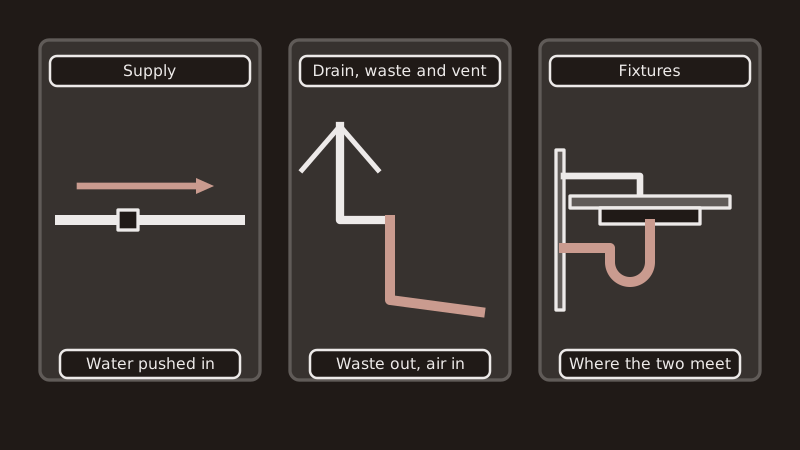
Supply and drain systems fail differently. Supply pipes leak or clog with scale and lose pressure. Drains block, and in old houses they crack or corrode. If your complaint is slow drains rather than weak flow, new supply pipe will not help, and the answer may be drain or sewer work. Read sewer line replacement costs for that route.
Common questions
How many years until supply pipes need replacing?
No fixed interval exists. No single clock applies. Material, water, pressure and workmanship all play a part. Corroded galvanized steel and brittle polybutylene top the list of reasons for older homes here. A plumber who can inspect the inside of the pipe judges its condition far better than a calendar can, and we found no verified local number to offer.
Does repiping a house near 2,000 square feet cost extra?
No verified price by square footage turned up. Bob Vila's national figures start at $1,500, end at $15,000 and average $7,500 (checked 2026-11-17). On a California contractor page, a whole-house repipe is $4,000 up to $15,000, with mid-sized PEX jobs mostly between $7,000 and $10,000. Only the quote on paper fixes the real number.
What is the 135 rule for plumbing?
No plumbing code or source we verified mentions a "135 rule", and guessing would be worse than saying so. If a contractor cites one, ask which code section or product instruction it comes from. Pressure and hot water limits are matters for the plumber and the California Plumbing Code.
Is a 1,200 square foot repipe much cheaper?
No verified price exists for that size in our research. The same national guide applies, with its floor of $1,500 and its ceiling of $15,000 (Bob Vila, checked 2026-11-17). Fixture count and access sway the quote more than floor area, so a compact house with two bathrooms may cost close to a bigger one. The repipe cost page breaks the price down.
Which comes first, the plumbing or the foundation?
On a new build, pipes under the slab go in before concrete is poured, and the rest follows the framing. For an existing slab house, a repipe normally leaves buried lines in place and routes new ones through attic and walls. Your floor plan decides whether that route works, and the plumber will say.
Guides in this section
- Galvanized Pipe Replacement
Galvanized water pipes in an older San Bernardino or Redlands house: signs of failure, replacement options, how long a repipe takes and…
- Pex vs Copper Pipe
Pex or copper for a repipe in San Bernardino and Redlands?
- Repipe a House
Repiping a house runs $1,500 to $15,000 in published guides.
References
- Bob Vila, cost to repipe a house, checked 2026-11-17
- Repiping.com, slab leak repair vs repipe (California contractor page), checked 2026-11-17
- City of San Bernardino, Building and Safety Division
- San Bernardino County Land Use Services, plumbing permits
- City of Redlands, Building and Safety Division
- California Contractors State License Board
- US Census Reporter, housing by year built for ZIP 92404, 92373 and 92374