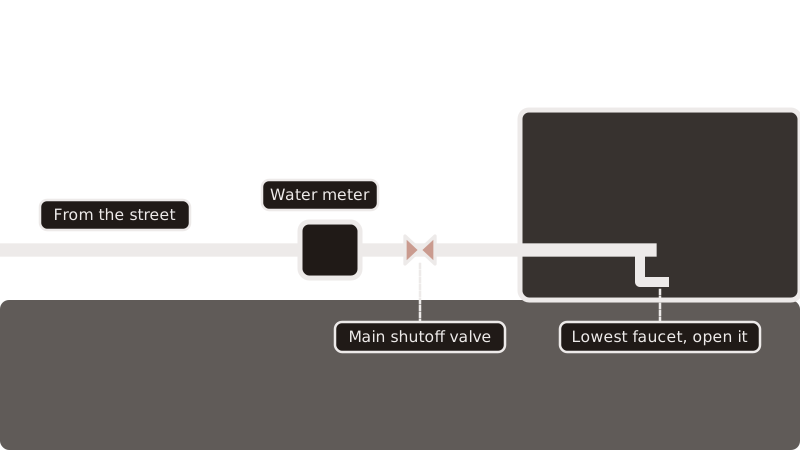
Ankle-deep in water, reach for the valve before the phone. Once the main is shut, dial the phone line up top or use the quote form. Either way we set up a plumber near you in San Bernardino, Redlands, Highland and Yucaipa. Below you'll find the first ten minutes, ways to trace a leak nobody can see, who covers the cost, and what moves a repair price. More of what we cover is on the home page.
Pipe just failed. Which steps come first?
Start at the main valve and close it. Next open the lowest faucet to empty the lines, then switch the water heater off, either at its dial or at the breaker. Shift valuables out of the soaked area, snap photos for the insurance claim, and stay out of rooms where a ceiling fixture is dripping. Phoning a plumber follows those steps.
Practice finding the main valve while nothing is wrong. Look along the front wall for the pipe stub that feeds the house, or lift the lid of the box by the street. Turn the handle a quarter and back. Older houses often hide a valve that has frozen solid with corrosion, and swapping one is routine plumber work.
Wet floors and a breaker panel do not belong together. Walk to the panel across dry boards only. If the route is damp, stay away and ring the electric utility, or 911 when anybody could be hurt.
Gas outranks water. Smell rotten eggs and everyone leaves the house first. Once on the sidewalk, ring SoCalGas on its emergency line, 1-800-427-2200. Use 911 if anybody could be hurt.
Water still pouring while you read this? Skip ahead to our burst pipe emergency page. Evening and weekend visits are covered in emergency plumbing.
How much harm does a burst line do?
Pressure keeps pushing until a valve closes, so harm grows by the minute. Drywall wicks the water upward, hardwood warps, and insulation stays sodden inside the wall. Mold can settle in where materials stay damp. Drying therefore matters nearly as much as the pipe, and the plumbing part is often the cheaper invoice.
A typical repair appointment goes in this order:
- Shut-off and tracing, following the wet patch back to the break.
- Cutting out the failed stretch or bad fitting and fitting new material.
- Pressure back on, joints watched for any weep.
- A word about other worn pipe nearby, such as old galvanized steel.
Dry-out crews, drywall hangers, painters and flooring installers each work separately. Have the plumber write down the cause and the location. Claims adjusters sometimes ask for it.
The EPA figure is sobering: a leaking home loses upward of 9,300 gallons a year, and a split pipe under full pressure can release water much faster than a slow household leak.
Does sealant or wrap tape work on a leaking pipe?
Putty, self-bonding tape and painted-on coatings will sometimes quiet a drip at a small, dry, clean spot. Calling that a repair would be wrong. A crack under live pressure, a worn joint or a pinhole in tired copper keeps going. Count a patch as a few hours of grace until help arrives.
Water off before application, since most coatings refuse to stick to damp metal. Tube thinned along its length tends to fail again beside the patch, and for that reason plumbers often replace a complete run. Pinholes in copper get their own walkthrough: repairing a copper pinhole leak.
How do you hunt down a leak behind the wall?
Go to the meter first. Confirm that no tap, ice maker or sprinkler is running, then read the dial. A turning low-flow triangle, or digits that creep, say water is leaving the property. Next, stain each toilet tank with food dye and wait, with no flushing. Tinted bowl water exposes a flapper that leaks silently.
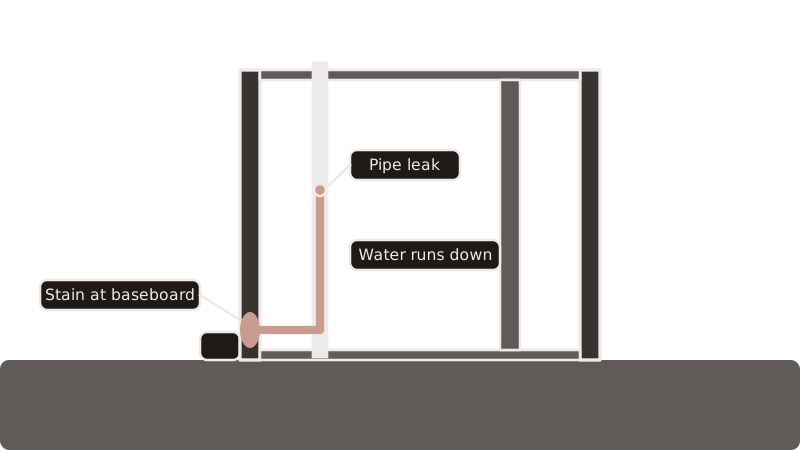
More clues, each pointing at a different place:
- Charges rising while usage stays flat, which the high water bill page unpacks.
- Musty air, a floor warm to bare feet, or trickling heard in a quiet house.
- Blistered paint, puffy baseboards, brown rings. Stains up high are dealt with in ceiling water leak.
- Pressure that sags without explanation.
Pipe buried in walls or concrete calls for kit most households lack: ground microphones, thermal imaging, gauges on isolated sections. Del Rosa shows why it matters. Census data for ZIP 92404 put the median home at a 1963 build, a period when galvanized steel and copper were both in use, and worn pipe can seep at multiple points. Too much pressure speeds the wear. The 80 psi fixture ceiling in CPC 608.2 is another reason the pressure regulator may get tested.
If the search ends under a slab, patch or repipe is the next decision. Slab leak repair or repipe argues both sides.
What are the signs a pipe has actually split?
Listen for hissing in a wall. Watch for sudden low pressure, damp baseboards, a ceiling that sags and bulges, or a meter that keeps turning overnight. Some breaks hide until a stain shows up. Is it a burst pipe? goes through each sign.
What do you pay to have a split pipe fixed?
Location decides most of it, plus how much of the wall or floor must come apart to reach the pipe. A garage ceiling line is a lighter job than one behind shower tile or under concrete. We found no verified San Bernardino or Redlands price for a burst pipe, so none appears here. For slab leaks, one national guide gives $630 to $4,400 (Bob Vila, checked 2026-11-17).
Treat each figure on this page as a guide, because the paper quote is what counts. Look at whether it includes finding the leak, opening and patching the wall, parts and any permit. Drying and finish work are frequently left out.
Four things move the figure:
- Reach: attic, crawl space, wall cavity or slab.
- Pipe material, and how much length is renewed.
- Hour of the call, since after-hours work often carries a premium.
- A second weak point exposed once the first is open.
More figures: slab leak repair costs and the broader plumber cost guide.
Who foots the repair when a line breaks?
Owners generally cover pipework on their own lot. Whoever supplies your water maintains the main under the road, and can tell you where its duty ends. If you rent, give the landlord written notice quickly, because California rental law counts working plumbing as part of a livable home.
Utilities vary by street. San Bernardino is divided among its municipal water department, East Valley Water District and Muscoy Mutual, while Redlands runs its own system. The name is on your water bill. California wants a contractor license for any job at $1,000 or beyond (labor and materials), and for all permit work. Verify a license number from a quote at cslb.ca.gov, the CSLB site.
Common questions
Does a homeowner policy cover a burst pipe?
Many do, for abrupt and unexpected water damage. Most draw a line at slow seepage that ran for weeks, and at replacing the faulty pipe. Wording differs by insurer, so read your policy or phone the carrier before anything else. Hang on to your photos and receipts, along with the plumber's note on the cause.
What is a water pipe repairer called?
A plumber. Whoever turns up may hold journeyman or master rank, and pipefitters mostly work on large industrial systems rather than homes. Once the visit is set up, a local plumbing business sends someone who inspects the trouble and puts the quote in writing.
Which four pipe types turn up in houses?
Homes around here usually have copper or PEX (cross-linked polyethylene) bringing water in, PVC or ABS plastic carrying waste out, and galvanized steel in older builds. Cast iron appears in some old drains. Failure modes differ by material. The PEX versus copper page covers the two common choices for supply lines.
How frequent are burst pipes?
We hold no local statistic we can verify, so we offer none. Leaks themselves are routine; the EPA estimates a leaking household loses over 9,300 gallons yearly. A full rupture is rarer, and old, corroded or over-pressured pipe is the usual cause.
Is a small leak worth a plumber's visit?
Yes. Behind a wall, a slow drip quietly rots the framing, and in old pipe a single weep often hints at more. Book before the stain spreads. Tell us on the quote form where the water shows, and we take care of the rest, including a written quote.
Guides in this section
- Emergency Plumber for a Burst
A pipe has burst in San Bernardino or Redlands?
- How to Know If a Pipe Burst
A stain that spreads, pressure that vanishes, a meter that will not sit still: how San Bernardino and Redlands homeowners can confirm a…
- Ceiling Water Leak
Water coming through a ceiling in San Bernardino or Redlands?
- Fix a Pinhole Leak in Copper
Pinhole leak in a copper pipe, a wet ceiling or a split line in the yard?
- Slab Leak Repair Cost
Published slab leak repair price ranges, what moves the cost for a San Bernardino or Redlands home, and what to ask before you accept a…
- Slab Leak Repair or Repipe
Found a leak under your concrete floor? How to choose between a spot repair and a full repipe, what each costs as a national guide, and…