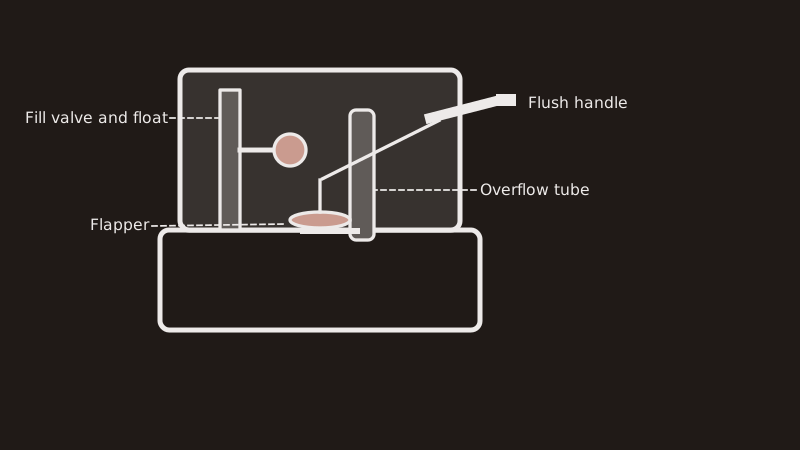
You hear water running at 3am. Or the bowl keeps refilling, though nobody has been near it. Most often, the culprit is a worn rubber seal inside the tank, and the repair is one of the cheapest in the house. Our toilet repair page handles the other fixture trouble, while the home page lists the other work we arrange.
Ahead: a dye check, a numbered swap, a symptom table covering other possible faults, and guidance on when to stop and hire someone.
How do I test whether that rubber seal leaks?
Add liquid food coloring, or a spoonful of coffee grounds, to the tank water and do not flush for roughly fifteen minutes. Color appearing in the bowl means the seal is passing water. A bowl that stays clear sends you to another part.
You can also listen. A whisper of water down the drain between flushes means the tank is slowly emptying, and the fill valve starts up every few minutes to compensate. Owners call that repeating refill a "phantom flush."
Finally, check the chain running off the handle lever. Pulled too tight, it keeps the seal from closing fully. Hanging too loose, it can drop a loop beneath the rubber edge.
Is it the seal, or something else that sounds the same?
A running tank has more than one possible cause, so match the symptom before you buy anything. The table below pairs each common sign with the part to inspect first, which saves a trip to the store for a flapper that was never the problem.
| Symptom | Where to look |
|---|---|
| Dye shows up in the bowl | Flapper, or the ring it rests on |
| Water spills into the tall standpipe | Float set high, or the fill valve |
| Nonstop refilling with a hiss | Fill valve not shutting off |
| Flush is feeble | Chain too slack, rim jets clogged, or a blockage |
| Wet floor at the base | Wax ring, closet bolts or the supply hose |
When water already pours over the lip of the standpipe, a new flapper changes nothing; adjust the float first. Related pages cover a running toilet, replacing a fill valve, and a feeble flush (toilet flush repair).
How do I swap it out?
The job takes five short steps and no special tools: shut the water, drain the tank, unhook the worn flapper, fit the new one and test it. Read through the list once before starting, keep a rag nearby, and work slowly, because the rubber and chain are easy to misalign.
- Turn the wall valve to off. Flush once to empty the tank and mop up the remaining water.
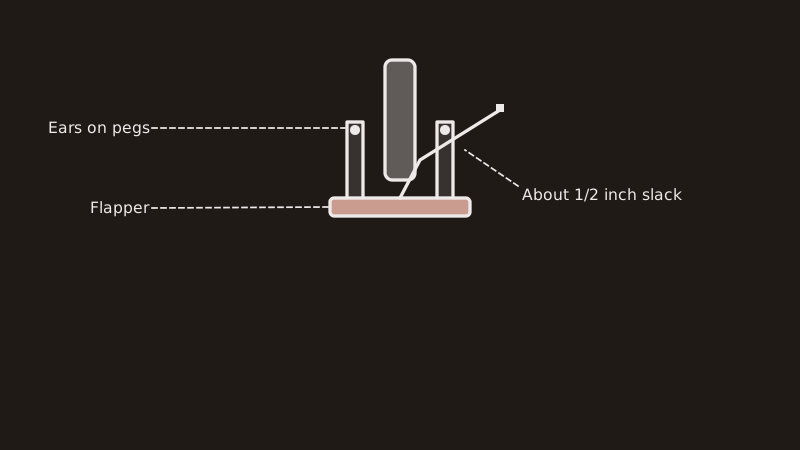
- Slide the two ears of the old flapper off their pegs on the standpipe.
- Free the chain from the handle arm.
- Seat the new flapper on the pegs, connect the chain in the same hole, and allow about 1/2 inch of slack.
- Turn the water on, flush twice, and watch the seal close.
Finding the right part is harder than fitting it. Take the worn flapper along, or photograph the model stamp molded into the tank. The opening is either two or three inches across, and a few makers use a shape of their own. Anything that nearly fits will drip like the old one.
One habit pays off: wipe the ring under the flapper with a damp rag first, since a little grit shortens a new seal's life. Leave bleach tablets out of the tank; they eat rubber.
Does hard water kill these seals faster?
It can. Scale builds up on the ring and leaves it rough, and a rough ring leaks even beneath a new flapper. The San Bernardino Municipal Water Department's 2024 report gives its customers an average of 242.67 mg/L hardness, roughly 14 grains per gallon once divided by 17.1. Reports for Highland, Redlands and Yucaipa show lower figures, and your bill tells you who supplies you.
Age counts too. Census figures show the biggest share of Del Rosa homes went up in the 1950s, and Redlands has many older houses still, so the part inside may be decades old.
With the water off, give the ring a gentle scrub with a nylon pad. A clean, smooth ring frequently seals again without buying anything.
Is a slow leak really a big deal?
Over weeks, yes. According to EPA, household leaks top 9,300 gallons yearly, and toilets are a frequent source. The leak makes no noise, so a larger bill is often the first sign. When the figure jumps, do the dye check before suspecting something worse.
The page on a water bill that suddenly runs high covers other suspects, including irrigation timers and slab leaks.
As a cost reference, This Old House lists toilet repair at $100 to $300 for a plumber visit. A flapper is a small piece of that. Whatever a visit costs is set by its written quote.
When should I stop and hire someone?
Call a pro once the trouble outgrows the seal: porcelain with a crack, a toilet that rocks, a wet base, a shutoff valve that sticks or drips, or a tank that has pulled away from the bowl. Work that opens a wall or floor also goes to a plumber.
Per the CSLB, California's contractor license law applies from $1,000 in labor and materials upward and to any permitted job. A flapper falls far short, though a toilet swap with new pipework might not be. Look contractors up on cslb.ca.gov.
On the quote page, describe the toilet, how it behaves and what you have tried. A local plumbing business, which pays us for the introduction, takes the request and replies with a written quote. If the whole toilet needs replacing, toilet replacement prices give typical ranges.
Common questions
What is the time commitment?
Once you hold the part, count on a quarter of an hour at most. Add the store trip and some test flushes, plus a little extra if the ring is scaly or the chain resists. It is a short job that fits before work.
Which flapper do I buy?
Two details decide it: the opening size (two or three inches wide) and the brand, if the toilet takes a special shape. The old flapper or the stamp inside the tank is what the store needs. Guessing causes most failures, because a part that is a bit off keeps dripping.
The toilet keeps running after I changed it. What now?
Check chain length first, followed by water level, then the ring for scale or a thin crack. Do the dye check once more to see if water still gets by. With a correct level and a smooth ring, suspect the fill valve next.
Is this one for a plumber?
Seldom. The part is inexpensive and a wrong move is easy to undo. Still, ring a plumber when the shutoff refuses to close, the ring looks cracked, the toilet is loose, or you would simply rather not risk a flooded bathroom. The written quote shows the price up front.