Test first, shop second. Your supplier sets how hard the tap water is, and that changes from San Bernardino to Redlands to Highland to Yucaipa. Next you choose who does the work, since a few pipe connections, a drain run and a salt habit all need thought. The hired route is described in softener installation by a plumber, and the quote form begins it. For other jobs, try the home page.
Is my tap water hard enough to bother?
Which figure applies depends on your supplier, whose name is on your water bill. San Bernardino Municipal Water Department customers averaged 242.67 mg/L in 2024, ranging from 120 to 330. East Valley Water District printed 152 ppm for 2025. Redlands listed 148 mg/L for groundwater and 117 for surface water, and Yucaipa Valley Water District 133.3 ppm. Dividing by 17.1 converts to grains per gallon.
That works out to about 14.2 grains for the SBMWD average, 8.9 for East Valley, 8.7 and 6.8 for the two Redlands sources, and 7.8 in Yucaipa. Never apply one supplier's figure to another's customers; Muscoy, Mentone, Crafton and Oak Glen addresses may be on other systems entirely, so ask the utility.
Whether those numbers justify a softener is a household call. Hardness leaves white crust on fixtures, spots on glasses and scale in kettles, and it can shorten a water heater's life. Some households simply tolerate it, and others prefer a cheap descaling habit.
Hardness strips sold in hardware aisles give a quick reading. Dip one at a tap inside the house, since a softener treats only what flows through it.
What does a DIY softener install require?
Pick floor space next to the incoming line, with a drain and a regular outlet nearby. Buy a bypass valve, fittings sized to your pipe, drain tubing, an air-gap fitting and bags of salt. A tubing cutter or push-fit kit, thread tape and a level complete the kit. Block out a whole day for a first attempt.
Check the practicalities in this order:
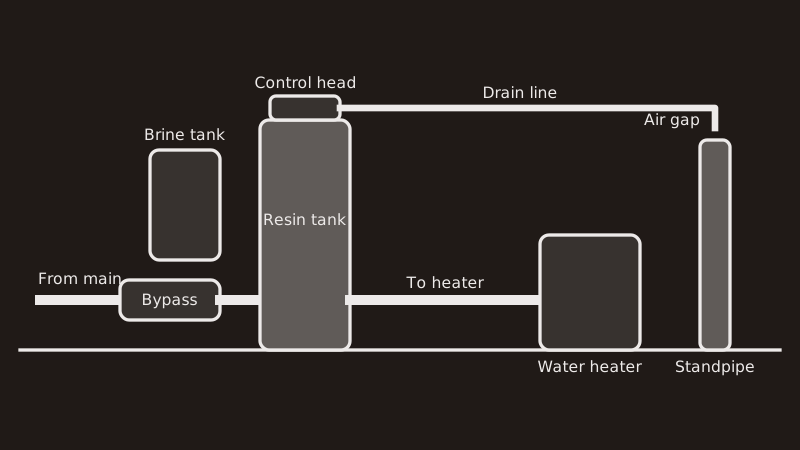
- Space: the tank and brine cabinet are roughly the size of a water heater and weigh a lot once loaded with salt. A flat floor matters.
- Pipe material: copper accepts solder or push-on fittings, PEX uses crimp rings, and galvanized steel in older homes is awkward to cut into and may be one for a plumber.
- Drain: the unit flushes itself, so its hose must end above a standpipe or floor drain with a visible gap, never sealed into it.
- Power: most control heads need an outlet for a small transformer.
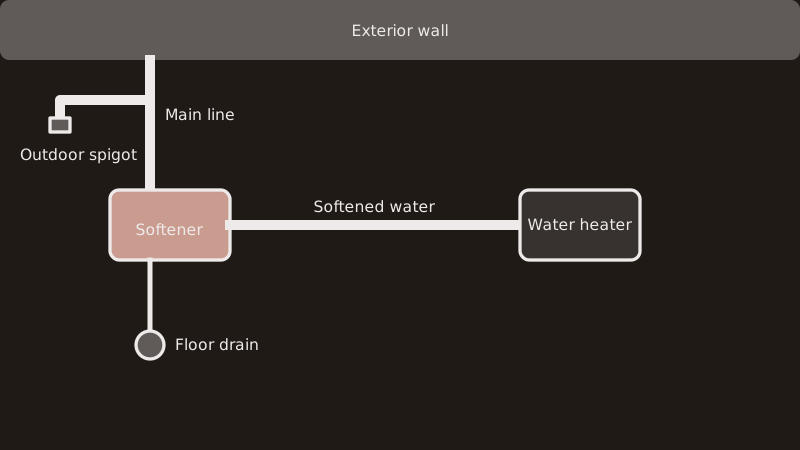
- Location: put it before the water heater and, if you want outdoor spigots unsoftened, upstream of the lawn tee.
Ask your water or sewer provider whether it limits how much brine a home may discharge. Some places do, and a restriction would shape which type you buy.
What is the installation sequence?
Close the main and empty the pipes at a faucet. Cut in after the main and before the water heater. Attach the bypass, connect inlet and outlet in the correct direction, run the drain tube to a drain that keeps a visible gap, add salt, plug in the head and key in your hardness. Open the main slowly, check every joint, and start the first regeneration.
In more detail:
- Attach the bypass valve to the head. Inlet and outlet are labeled; swap them and nothing softens.
- Make a square cut, deburr it, and slide on fittings or flexible connectors.
- Dry-fit everything before tightening. The pipes should not pull on the head.
- Route the drain tubing so it ends above the drain. Add the overflow tube if the kit supplies one.
- Add resin only if the tank shipped empty. Put a little water in the brine tank, then the salt.
- Start in bypass, open the main, then move to service. Bleed trapped air at a faucet.
- Plug in, set the clock and your measured hardness, and start a manual regeneration.
Check a softened tap the next day. A strip reading near zero shows the unit is working.
Is installing a softener myself legal?
Rules vary by city, and we cannot say if yours wants a permit for a softener, so ask your building office. The state is clearer on one point: California requires contractor licensing for paid work from $1,000 (labor plus materials) and for anything needing a permit. Gas lines are a separate matter and no DIY topic.
For the City of San Bernardino, Building and Safety answers on 909-998-2000. Highland's counter takes calls on 909-864-6861, extension 232. In Redlands, call 909-798-7536, in Yucaipa 909-797-2489, and in Muscoy, Mentone, Crafton or Oak Glen the county's Land Use Services handles building at 909-387-8311. We cannot say a given permit is needed; the office can.
Hiring out? Request a written quote, then look up the contractor's name on cslb.ca.gov. A large deposit request deserves a second look, since the board generally caps deposits at the smaller of 10% or $1,000. Confirm that with the CSLB.
What does it cost to do it myself or hire out?
Fixr prices a softener plus installation at $1,100 to $3,000, with $2,500 as the average. For labor by itself, Bob Vila shows $150 to $1,000. Doing it yourself trims the labor line but not the unit, the salt or your Saturday. Both are national guides, not local rates, and a plumber's written quote carries the real price.
The wide spread comes from the unit. Small timer-based softeners sit at the bottom, and large metered units with high capacity cost more. Plumbing complexity pushes labor up: long runs to the drain, a hard-to-reach main, galvanized pipe or a copper loop that needs rerouting.
Take the cost page, water softener installation cost, alongside your own quotes. A cheaper option is not always the better one.
Can I get rid of existing scale without a softener?
Yes. White vinegar softens limescale on faucets and showerheads: tie on a soaked cloth or bag for an hour, then scrub. Citric acid does the same inside kettles. A softener heads off new scale without stripping old crust from fixtures, and deposits inside pipes will not simply melt away.
For a water heater, flushing a few quarts from the drain valve once or twice a year removes loose sediment, and it takes ten minutes. Never use vinegar on natural stone or unsealed grout. Replace aerators and showerheads that stay clogged.
Scale also shortens the life of heating elements and clouds glass. If you are chasing a recurring problem, a water heater that stops giving hot water may point to a scaled element or tank.
When does hiring make more sense?
Call a pro when the incoming pipe is galvanized or corroded, the drain is a long way off, several pipes need altering, the main valve leaks, or a free weekend is worth more to you. A plumber knows where to cut, how to leave the drain gap and how to match the unit to your household's demand.
Self-installs go wrong on the supply side, where one weak joint near the main can flood a garage. Doubt about your pipe is reason enough to book someone.
Common questions
How many hours does the job need?
When pipe and drain are easy to reach, a plumber can often finish inside half a day. A first-timer should plan a full day plus store runs. Leave time for the first regeneration, and look over each joint again the next morning.
Do softeners remove all minerals from drinking water?
No. A salt-based unit trades calcium and magnesium for sodium or potassium, so scale drops while everything else dissolved stays in the water. Drinking-water quality is a different topic: your supplier's annual report lists what is in it, and filters do that job.
Where does the salt go and how often do I refill?
Salt goes into the brine tank, usually a bucket-sized chamber beside the resin tank. How often you refill depends on water hardness, household size and the unit's settings; many households top up every month or two. Check the tank each month at first, and keep the salt level above the water line.
Could the unit harm my plumbing?
Not when it is fitted correctly. The bypass lets you isolate it for service. Bad connections or a blocked drain tube are what cause leaks and wet floors. Fitting it upstream of the heater protects the heater too, as scale contributes to tank wear.
References
- San Bernardino Municipal Water Department, 2024 Consumer Confidence Report
- East Valley Water District, 2025 water quality report
- City of Redlands, 2026 water quality report
- Yucaipa Valley Water District, annual water quality report
- Fixr, water softener installation cost, checked 2026-11-17
- Bob Vila, water softener system cost, checked 2026-11-17
- California Contractors State License Board