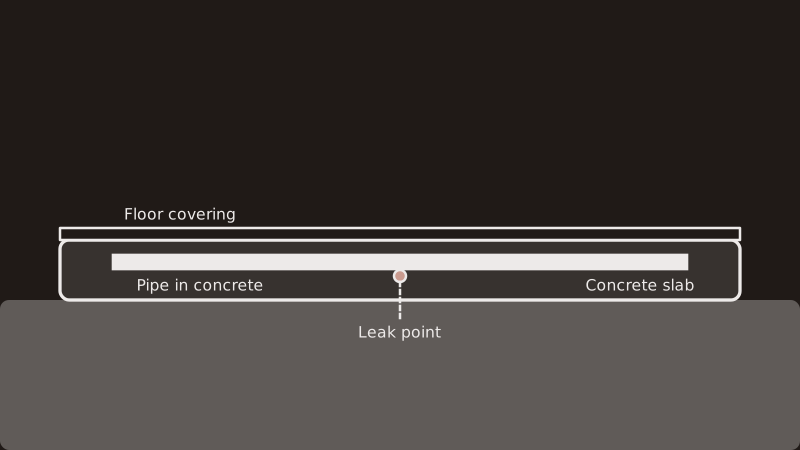
Somewhere in or below your foundation, a supply pipe is leaking, and the decision is whether to fix that one spot or to replace the pipework entirely. When the pipe is otherwise healthy and this is its first failure, the spot fix normally wins. When failures repeat, or the material is known for giving out, replacement becomes the stronger option. Either way we arrange a plumber to do it. General leak advice lives in leaks and burst pipes, while the Smudge Pot Plumbing front page has our other services.
Is one repair enough, or should the whole system be replaced?
A spot fix suits a single confirmed leak in pipe that looks sound, at a house you intend to keep. A repipe suits a house that has already sprung two leaks, pipe made of galvanized steel or otherwise close to retirement, or metal next to the break that appears thin and pitted.
Think about the cost of every return visit. Reaching a pipe beneath concrete is expensive each time, so three slab repairs within a few years may add up to more than a single repipe. A first leak in newer copper does not carry that risk, and the spot fix costs less on the day.
A home's age hints at its pipe age without proving it. Median build years from the Census are 1963 in ZIP 92404 near Del Rosa, 1976 in Redlands ZIP 92373, and 1987 in ZIP 92407 covering Verdemont and Arrowhead Farms. Older plumbing has had longer to corrode, but the material the plumber really finds is what counts. Our galvanized pipe replacement guide describes one common older material.
What clues point to a leak beneath the floor?
A slab leak rarely stays hidden. Warning signs: warm floor spots, a hiss from the walls while all taps are closed, wet carpet, flooring that buckles, a musty smell, and a sudden jump on the water bill. Pressure from below can crack tile too.
A meter test is worth doing. With every water-using appliance and tap idle, open the meter lid and watch the low-flow dial or leak indicator. A moving dial confirms water is escaping. Next, shut the house-side valve and read the dial a second time. Should it carry on turning, the leak sits upstream of that valve, outside your walls.
If the dial goes still after that valve is closed, the leak is somewhere in your own piping, and detection is the following step. The plumber sweeps the floor with acoustic listening gear to find the exact line before cutting any concrete. We could not verify a detection price, so have it written on a separate line of the quote.
Which methods can fix a pipe that is buried in the slab?
Plumbers usually pick from three. One cuts into the concrete above the leak and swaps out that length of pipe. Another retires the buried line and installs a replacement overhead in the walls or attic, called a reroute. The last coats the pipe's interior with epoxy. Each approach suits a different pipe condition and floor finish.
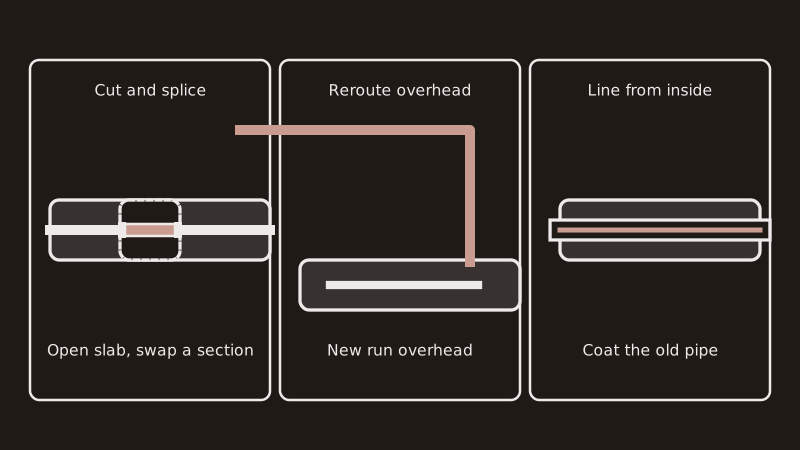
Breaking through is the most direct approach, yet it involves jackhammering, patching the concrete and rebuilding whatever sits on top, be it tile, wood or carpet. A reroute leaves the slab whole but opens wall sections. Lining avoids digging, though the pipe must be in good enough shape to accept it, so not every line qualifies.
Ask the plumber which approach suits your pipe and your flooring, and what the written quote covers for drywall and floor patching. Those finishing items are often priced apart, and they can tip the comparison between methods.
What happens during a repipe when the floor is concrete?
Most of the time the concrete is left alone. Fresh supply pipes are routed across the attic or inside the walls, ending at each fixture, and the old underground runs are capped and abandoned. For the replacement run, installers lean on PEX or copper, and PEX versus copper weighs up.
Because walls are opened, a repipe involves nearly as much patching and painting as plumbing. Permits matter as well. The state board says any job needing a permit calls for a contractor who holds a license. San Bernardino city accepts single-family water re-pipe permits through its online system.
Whole-house pricing sits on the repipe cost page. The office that issues your permit depends on the address: the City for properties inside San Bernardino, the County for unincorporated places like Muscoy, and the individual city for Redlands, Highland or Yucaipa.
What is the price difference between the two?
These are national guides, not San Bernardino bids. For slab leak repair, Bob Vila gives a span of $630 to $4,400. Fixr gives a band starting at $1,000 and ending at $4,000, with $2,500 in the middle. For repiping, Bob Vila starts at $1,500, tops out at $15,000 and averages $7,500. The figure that actually applies is on your written quote.
Several factors move the number: how deep and how far the pipe runs, how much concrete and flooring has to come out, which method fits, and for a repipe, how large the house is. Detection, permits and patching may fall outside the headline figure, so ask what is included and what is not.
You can find a longer breakdown in slab leak repair cost. Waiting is where money slips away. The EPA reports that an ordinary household leak wastes more than 9,300 gallons a year, and damage to floors and walls keeps growing.
Does water coming through a concrete roof count as a slab leak?
No. A plumber uses the term for a supply pipe failing in or under a foundation. Water showing through a concrete roof deck is nearly always a waterproofing or drainage fault. Plumbers are the right call only when the source is a roof drain line or a pipe passing through the roof.
Membranes, flashing and cracked concrete belong to a roofing or waterproofing contractor. Unsure which one you have? Record where the wet spot sits, whether it shows up after rain or after you run water, and whether the meter keeps ticking when all use is off. That pattern generally answers it.
Common questions
Which is faster, a patch or a repipe?
We name no duration, because the method and the house change it. Spot repairs usually wrap up ahead of a reroute, while a whole-house repipe takes the most time because it opens up more wall. Get the schedule in writing, drying and patching included, and find out when the supply will be shut.
What should I settle before authorizing the job?
Find out which method is suggested and the reasoning, how the quote handles permits, concrete and wall patching, and who the contractor is. California demands a contractor license for permit work, and for any job whose labor plus materials reaches $1,000. Use the CSLB lookup to verify a license number.
Do I have to treat a slab leak as an emergency?
Call it urgent, though often short of a true emergency, as long as the house supply can be closed. Water that keeps running under the house erodes the soil around the foundation, so keep the valve shut until help arrives. Water climbing toward outlets or appliances is an emergency, and emergency plumbing covers it.
Does a buried pipe burst like one in a wall?
Typically it starts as a pinhole or small split that seeps instead of spraying, and it can run quietly for weeks. A burst is a sudden break that floods quickly. Either way a plumber is needed. To see which one you have, use how to know if a pipe burst.
References
- Bob Vila, slab leak repair cost, checked 2026-11-17
- Fixr, slab leak repair cost, checked 2026-11-17
- Bob Vila, cost to repipe a house, checked 2026-11-17
- EPA WaterSense, Fix a Leak Week
- California Contractors State License Board
- City of San Bernardino Building and Safety Division
- US Census Reporter, housing by ZIP code (B25035), checked 2026-11-17