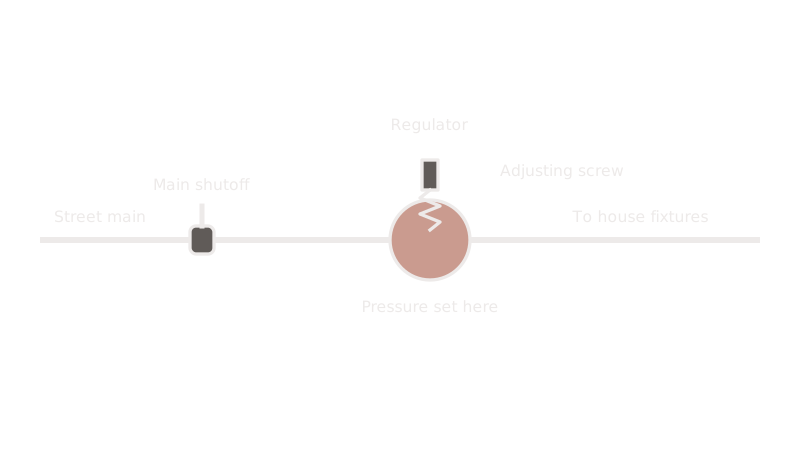
Take a reading first. Put a gauge on the outdoor spigot, turn off all indoor taps, and record the static number. If it is off target, back out the locknut on the regulator and tweak the adjusting screw in small increments, glancing at the gauge each time. Turning clockwise usually raises pressure. If the screw is frozen, stop there, read the low water pressure page and book a visit.
How does the regulator lower my water pressure?
A spring bears down on a diaphragm inside the bell, and that diaphragm moves a valve. Water arrives from the street at high pressure; the spring's tightness sets how much gets through. Turning the screw tightens or relaxes the spring, so the pressure in your pipes moves with it.
Hence the odd symptoms of a dying one. With a worn diaphragm, either the whole street pressure leaks past, or flow gets throttled and showers dribble.
To find yours, walk to the main shut-off and look just past it. Typical hiding places are along a garage wall, in a box at the side of the house, or beneath the house in a crawl space. A few houses have no regulator, and then the causes of low pressure are a separate list.
The ceiling for fixture pressure is 80 psi, per CPC section 608.2. Some households run lower still, and a plumber can propose a target for your fixtures.
What symptoms say the regulator is failing?
Four clues stand out: pressure that builds overnight with nothing running, hammering pipes, a spigot that reads over 80 psi, and weak flow at every tap together. Damp metal around the bell is a fifth. Any one is enough reason for a quick test.
Here is the test:
- Connect the gauge to the outdoor tap closest to the main.
- Shut all taps and make sure the dishwasher, clothes washer and ice maker are idle.
- Record the number, give it 10 minutes, then read it again.
- If it creeps up, the valve is failing to hold. If it sits over 80, the valve is not cutting pressure enough.
Hardware stores sell gauges for little, so you can do this before paying anyone.
What is the procedure for adjusting it?
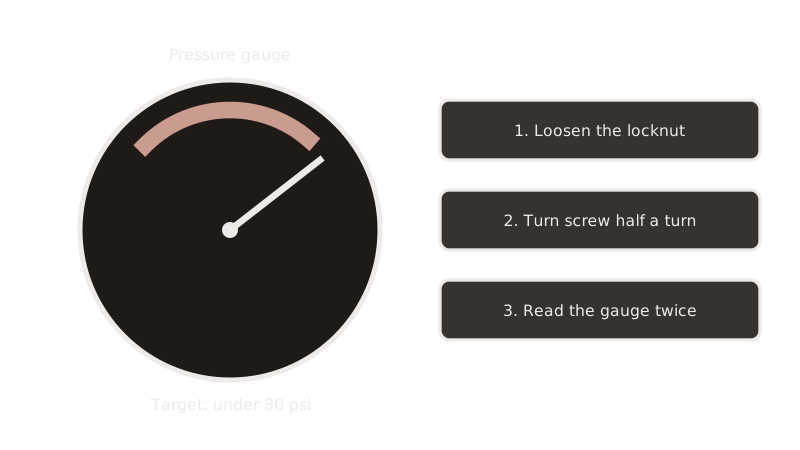
Free the locknut, then give the screw about a half turn. Snug the nut back down and read the gauge twice, first with every tap off, then with one open. Keep at it until you see less than 80 psi. High pressure is not the goal. A moderate setting is easier on the water heater and every fixture.
Snags worth knowing:
- Expansion. In a closed system heated water cannot expand backward through the regulator, so pressure rises downstream. An expansion tank is frequently the cure; ask whether yours already has one.
- Locknut. If the nut is stuck, leave it. Brute force can crack the bell.
- Showerheads. Their flow restrictor reduces flow rather than house pressure, so it does not replace a regulator.
- Pumps. Well and booster pumps use a pressure switch, a separate part and a different job.
- Hose-end regulators. A little inline unit on a garden hose protects the hose or sprinklers, nothing indoors.
What tells me the regulator should be replaced?
When the screw has no effect, the pressure keeps drifting up, water weeps from the bell, or the unit is simply old. No source we read gives a fixed lifespan; trade talk runs around a decade or longer, but that is a loose guide, and the gauge is the better judge.
Expect real work. The main is shut, the line drained, fittings loosened or cut, and a new valve fitted. Ask your building office whether a permit applies. We could not verify a rule in either direction and will not guess.
- City of San Bernardino: 909-998-2000
- City of Redlands: 909-798-7536
- County Land Use Services, for unincorporated areas: (909) 387-8311
Licensing is separate. California looks for a contractor license on any job totaling $1,000 in labor and materials, and on every job that needs a permit.
Prices are on their own page: regulator installation cost.
Should I just hire a plumber?
Do it if the gauge sits above 80 psi however you set the screw, if the valve leaks, if pipes slam, or if the task involves cutting into the main line. Excess pressure can also appear as leaks elsewhere, so see help with leaks too.
A plumber brings a gauge, tools and spare parts, and can inspect the water heater and expansion tank in the same trip. Include your readings when you fill in the quote form, and we do the booking. The home page lists other services.
Common questions
How long does the visit run?
Tuning a valve within easy reach can be quick. Replacing one takes longer, since water is shut off and the pipe opened. We cannot dictate the plumber's duration, so ask at booking for a written time window. An uncluttered route to the valve helps the most.
Which questions suit the installer?
Check that the quote lists the valve, fittings, an expansion tank if one is needed, and the permit when it applies. Ask what target pressure will be set and how a gauge will prove it. Ask who honors the part's warranty, and obtain the contractor license number so you can verify it with the state.
Is someone required to be home for the swap?
The plumber needs a free path to the shut-off and the valve, and the faucets run dry for a stretch. Whether you must remain is the plumber's decision, so raise it when booking. Time laundry and showers elsewhere, and remember anyone in the home who needs running water.
Can a hose regulator tame pressure inside the house?
No. One fitted to a hose end or sprinkler line protects only that line. House pressure is set by the valve near the main, which means a high spigot reading calls for checking or replacing that valve rather than adding a gadget at the tap.
References
- California Plumbing Code, section 608.2 (80 psi limit at fixtures), as cited in the project fact sheet, checked 2026-11-17
- City of San Bernardino Building and Safety Division
- City of Redlands Building and Safety Division
- San Bernardino County Land Use Services, plumbing permits
- California Contractors State License Board