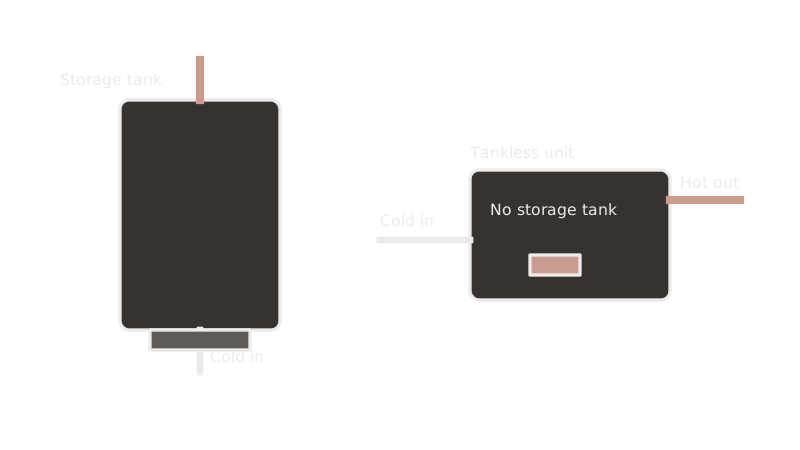
Pick a tank if low price and a familiar setup matter most. Pick tankless if the budget stretches, showers run back to back, and keeping forty or fifty gallons hot all day bothers you. Whichever you choose, the job belongs to the broader water heater service we arrange for San Bernardino and Redlands.
Ahead: installed prices, operating costs, the hard-water problem that matters locally, and how gas, electric and propane change things.
How do I decide between them for my own house?
A tank has the edge in upfront cost and simple swaps. A tankless unit has the edge in endless supply and in the floor space it frees. What usually decides it is how many people want hot water at the same moment, plus what the house already has: a gas line, a vent, a spare circuit, a closet.
Keeping the same fuel keeps the job small. Going from tank to tankless can drag in a bigger gas line, a new vent or electrical work, and those add-ons shift the quote more than the heater itself does.
For tankless numbers specifically, open the tankless installation cost guide.
Can tankless units be repaired, and is a permit needed?
Both answers are yes, with caveats. Sensors, igniters and valves can be swapped, and descaling is routine. The water heater repair hub outlines what a visit can include, and a unit that dies in midwinter falls under emergency water heater repair.
Replacement is different. The City of San Bernardino's Building and Safety page says water heater replacements are usually permitted directly over the counter, while the County's plumbing page lists change-outs and tankless installs as permit projects. Ask who files it.
Not sure the heater is to blame? Start with what causes a loss of hot water.
How do fuel types and small tanks affect the choice?
A gas tankless unit draws far more gas at one time than a tank's burner, so the supply pipe might have to be enlarged. Gas piping in California is for contractors, usually with a permit, and the gas line work page covers it. Electric tankless units draw heavy current, which means the panel and wiring get checked.
SoCalGas covers most of the area, but Oak Glen is missing from its published list of cities, so ask the plumber which fuel your address can use. Homes beyond the gas main can use propane tanks.
Mini tanks are compact storage heaters placed near one sink or shower. It suits one outlet, not a whole house.
Will San Bernardino and Redlands water change which one I buy?
It does, in favor of planning for scale. Dissolved minerals settle inside any heater, and in a tankless heat exchanger the tight passages lose flow and efficiency as deposits form. Hardness varies by supplier, and your bill shows who serves you.

| Supplier | Reported hardness | Source year |
|---|---|---|
| San Bernardino Municipal Water Department | 242.67 mg/L average, range 120 to 330 (about 14.2 grains per gallon) | 2024 |
| East Valley Water District (Highland) | 152 ppm | 2025 |
| City of Redlands | 148 mg/L groundwater, 117 mg/L surface water | 2025 |
| Yucaipa Valley Water District | 133.3 ppm, range 92 to 290 | 2025 |
Each figure holds only for that supplier's own customers. A whole-house softener, described on the softener installation page, or a scheduled flush of the unit can slow buildup.
Which costs less to run, and can I work it out myself?
Tankless saves energy chiefly because there is no big tank sitting hot around the clock. U.S. Department of Energy guidance, repeated on third-party pages, says light users (up to 41 gallons of hot water daily) save 24 to 34 percent, and homes near 86 gallons save 8 to 14 percent. The Energy.gov page itself would not load for us, so read both as rough guides.
A three-number calculator is easy to build: gallons of hot water per day, your gas or electric rate, and the efficiency on each unit's label. Multiply, compare, then divide the price gap by the annual saving to estimate payback.
Payback commonly takes years. Lifespans differ as well: that Energy Department guidance, as quoted elsewhere, gives storage tanks about 10 to 15 years and tankless units more than 20. Ask the plumber what the label says for the exact model quoted.
How far apart are the prices?
Bob Vila's typical replacement range runs from $874 to $1,765, with a national average of $1,293. For tanks it cites an average near $1,000, and for tankless near $2,500, without ranges for either. This Old House lists installation by itself at $800 to $2,000.
The final figure comes from your written quote. National averages leave out whatever your house may require: a new vent, a larger gas line, a permit, disposal of the old tank.
What moves the number is explained on the replacement cost page. We read no San Bernardino price, so none appears.
Common questions
How long is a conversion to tankless?
That depends on the vent, the gas line and the wiring. Exchanging one tank for another is the shorter job, while converting to tankless involves more steps. We cannot promise the plumber's duration, so request a time window in writing before you agree.
What should I ask when comparing water heater quotes?
Learn what the number contains: venting, gas or electrical changes, the permit, taking out the old unit and patching walls. Then ask for the exact model name, the manufacturer's printed warranty, how the unit will be strapped and flushed or descaled, and who handles a claim later.
Does somebody need to be home for the swap?
The plumber must be able to reach the heater, the main shutoff and the gas or electrical controls. Whether you must stay is the plumber's call, so ask at booking. Water service is interrupted for part of the visit, which matters for households with babies, medical needs or no backup supply.
Which handles a busy household better?
A tank handles several showers until the supply runs low, then you wait while it recovers. Tankless never runs out but limits how many outlets it can feed together. Think of your busiest morning, then ask for a unit sized to match that peak.
Do older tank-versus-tankless comparisons still hold up?
The core trade-off is unchanged: tanks cost less up front, and tankless costs more but saves energy. Prices, models and efficiency labels do change, so lean on a current written quote, one that names the model and what the work includes. You can request one through our quote page.
See plumber across San Bernardino for the other services and what they cost.
References
- Bob Vila, water heater replacement cost, checked 2026-11-17
- This Old House, plumber cost guide, checked 2026-11-17
- San Bernardino Municipal Water Department, 2024 water quality report
- East Valley Water District, 2025 water quality report
- City of Redlands, 2026 water quality report
- Yucaipa Valley Water District, 2025 water quality report
- City of San Bernardino Building and Safety Division
- U.S. Department of Energy guidance on demand-type water heaters, as quoted on third-party pages, checked 2026-11-17