A puddle under a tank ends one of two ways. Either a small part gets tightened or swapped, or the heater is retired. Which ending you get hinges on exactly where the water emerges, and finding that needs a torch, a dry cloth and some patience. It forms one branch of our water heater repair guidance and covers isolating the heater, reading the wet spot, and spotting the moment a plumber becomes necessary.
What should I shut off the moment I see water?
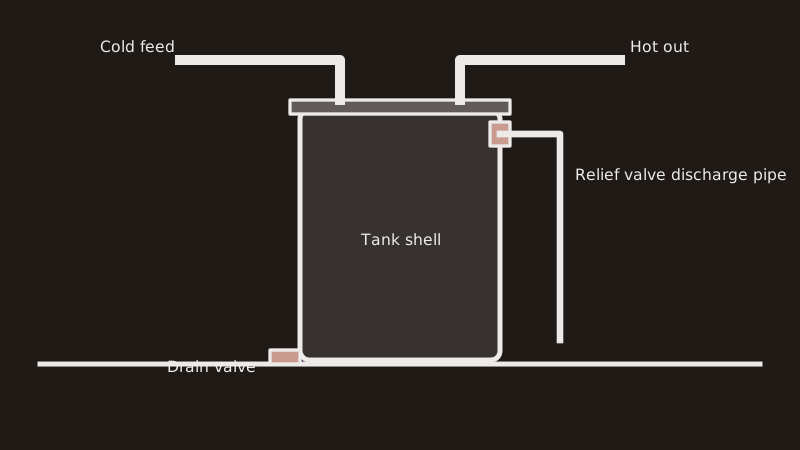
Shut the cold feed above the tank, then cut power or gas to the unit. Keep family and animals away from the wet floor. That feed is the pipe dropping into the heater's lid; closing its handle all the way stops new water arriving, so the leak weakens even while its cause stays unknown.
Now the energy. Electric heaters have their own breaker; flip it, but never cross a flooded floor to reach the panel. Gas heaters have a control dial, which goes to pilot or off. A sulfur smell trumps all of this: get outdoors and ring SoCalGas, 1-800-427-2200, falling back on 911 only if it fails.
Speed matters, because slow drips are costly. For scale, EPA says the average household leak runs to more than 9,300 gallons a year, so a closet that stays damp left damp for weeks can ruin flooring and wall framing before any bill hints at it.
Is the leak at a fitting, a valve or the tank?
Dry every surface, then press a twist of dry tissue to each suspect joint, then come back in sixty minutes. The first scrap to darken marks the culprit. Connections at the top often weep. A side valve with a pipe to the floor is the relief assembly. Moisture at the foot could be the drain spigot or the tank shell itself.
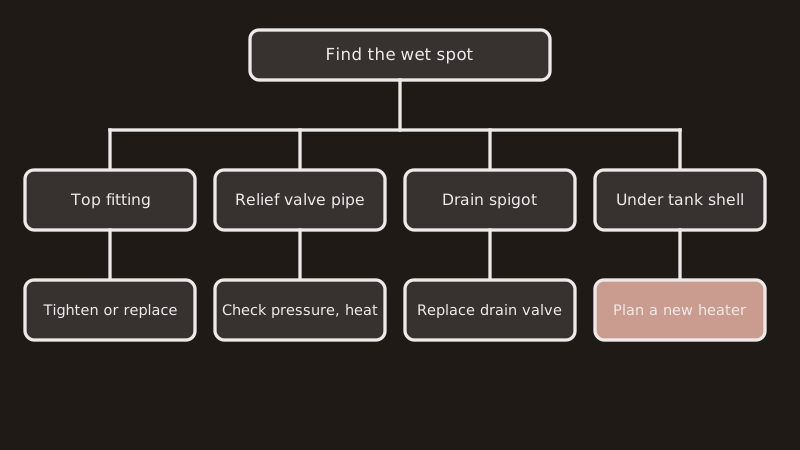
| Wet area | Probable cause | Realistic outcome |
|---|---|---|
| Unions and flex lines on top | Worn or loose fitting | Frequently a quick repair |
| Pipe beside the side valve | Relief valve discharging | Depends on pressure and heat, see below |
| Spigot near the floor | Drain valve seat | Inexpensive part |
| Access plate on an electric unit | Element gasket | Sometimes fixable |
| Under the tank with a soaked jacket | Corroded shell | Heater replacement |
Plenty of damp patches are no leak at all. Cold tanks in humid garages sweat, and condensing gas heaters or tankless units produce water on purpose, routing it to a drain. When the patch appears only after long showers and dries by evening, bring that observation to the plumber before replacing anything.
Which of these leaks can a homeowner repair?
Two jobs are realistic at home: snugging a loose fitting and replacing a weeping drain valve. Nudge a compression nut about a quarter turn, retest, and repeat. Change a tired flex connector only after water and power are both off. The line sits at gas piping, gas control valves and wiring, which are contractor work.
Anything involving a new heater, new gas connections or rerouted copper falls into permit territory. The CSLB, the state contractors board, restricts permit work to firms with a contractor license from California, and a heater replacement is permit work. Not sure where your leak belongs? Take a photo and attach it to your submission.
Why is the relief valve at my heater dripping?
Treat it as a message from the heater. The valve opens to dump water when pressure or temperature runs too high. So blocking the outlet pipe is never the fix. Usual triggers: excessive house pressure, a thermostat cranked too high, hot water expanding with nowhere to go, or a valve worn out by age.
Begin with a pressure gauge, which threads onto an outdoor spigot. Under CPC 608.2 the ceiling at fixtures is 80 psi, so anything higher points at the regulator, and the regulator adjustment page lists the symptoms. A closed system often needs an expansion tank. A brand new valve that drips as badly as the old one confirms that pressure or heat is the real culprit.
When has the tank itself given up?
When every joint and valve is dry and water still gathers beneath the tank, the steel has rusted through from inside. No sealant, putty or epoxy rescues a pressurized tank, so the straight answer is a new heater. Rust streaks on the jacket and brownish hot water usually travel with that failure.
An earlier check can delay it. Hanging inside the tank is an anode rod, a metal bar that rusts away instead of the tank walls, and a spent one is a reason tanks fail early. The anode rod guide shows how a plumber inspects it. Once the shell is leaking, though, that check is too late.
Picking the next heater is its own decision. Compare tank and tankless models, then see what a new unit costs.
What does fixing a leaking water heater cost?
National guides show the scale. This Old House lists repair at $150 to $750, and Bob Vila puts typical replacement between $874 and $1,765 (both checked 2026-11-17). Neither is a San Bernardino quote, and the figure that counts comes from your written quote. Fittings and valves land low in that spread, while a dead tank moves you to replacement figures.
Four factors push the figure around: the part itself, how awkward the heater is to get at, any gas or vent changes, and the permit attached to a replacement. A cramped hallway closet takes more labor than a roomy garage corner. Ask for pricing broken into parts, labor and permit, so two offers are easy to weigh.
Do Rheem, Whirlpool, Bosch or A. O. Smith leaks need different handling?
Not much. The wet-spot table works for all of them. Where makers differ is the supply of parts. Drain valves, relief valves and element gaskets for popular tanks are easy to source, but a tankless heat exchanger is cut to a single model. Warranty terms on the tank vary by maker, so read the paperwork that came with the heater.
Write down model and serial from the data plate, and photograph the wet spot plus the area around it. One clear picture often stops a plumber turning up with the wrong part.
When does a leak count as an emergency?
Water touching a ceiling, outlets or a hallway counts, as does a tank spraying and any case where you cannot reach the shutoff. Isolate what you safely can, then turn to urgent water heater repair. Broader drip problems fall under plumber for leaks, while a water heater leak plumber article approaches the same fault from the hiring side.
Prefer to hand it over? Send your request and we line up a local plumber who looks at it and quotes in writing beforehand. Remaining services are listed on the Smudge Pot Plumbing home page.
Common questions
How do I tell condensation from a genuine leak?
Condensation beads lightly on cold surfaces during humid weather or after heavy use, then dries without help. A genuine leak keeps producing water, spreads over hours and returns when you wipe it away. Press dry tissue to the spot for a few hours. A soaked strip means a real leak, so isolate the heater.
Is there a sealant that repairs a leaking tank?
No. Sealants and epoxy may calm a weeping thread on a drain valve or fitting, yet they cannot make a pressurized steel tank safe after water breaches the shell. Shut off water and power, then plan for a replacement instead of a patch.
How can I drain a leaking tank?
Switch the heater off, close the cold feed, and fit a hose to the drain spigot, aimed at a floor drain or the yard. Open a hot faucet inside to admit air, then open the spigot. Let the water cool beforehand, because it can scald.
When does a slow pipe drip justify a call?
Yes, once a gentle nudge on the fitting does not stop it. A steady drip wastes water, stains finishes and signals a worn connection. Drips from the relief valve pipe deserve faster attention because they can mean excess pressure or heat. Describe the location and add photos to your request.