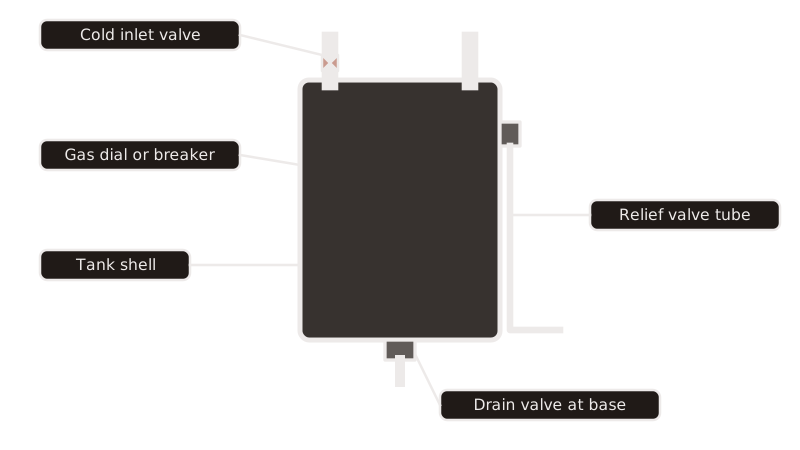
A puddle around a heater usually has one of three origins. Either a connection has loosened, a safety valve is discharging, or the tank wall has corroded through. Loose connections and valves can be repaired, while a corroded tank is done for. So begin by taking away the electricity or the gas, then shut the cold pipe that supplies the tank. To see how a visit gets booked, open the water heater repair hub. The Smudge Pot Plumbing front page lists every other service.
Is a dripping heater really something to hand to a pro?
Most of the time, yes. Diagnosing a loose union versus a dead tank is not obvious from the floor, and a new heater usually needs a permit, so check with the local building office. A quick turn of a wrench on a weeping nut could hold for a day, yet someone should still examine the unit.
Everything hinges on the tank. Seepage through its outer shell, commonly near a seam or the base, tells you the inner lining is gone permanently. A tired valve or a drain tap that leaks costs much less to put right.
Gas models raise the stakes. Gas piping is not a casual DIY job. A California contractor license is required whenever the combined cost of labor and materials hits $1,000, or the work needs a permit.
Should I patch the heater or pay for a new one?
Repairing makes sense when the culprit is a connection, valve or drain tap, because each is a modest part compared with a whole tank. Replacing is the better path for a leaking tank, or for a worn heater that has been patched already. Once the water is shut, whoever visits can sort yours into one camp or the other.
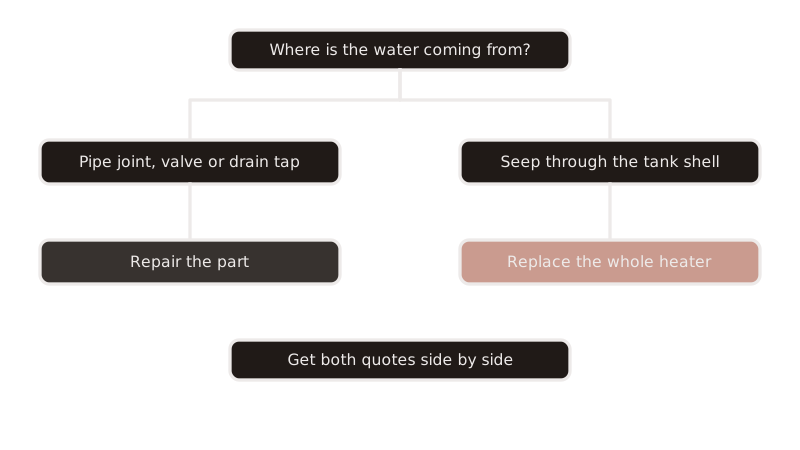
For national context, This Old House lists repairs from $150 to $750, while Bob Vila lists replacements from $874 to $1,765 and an average of $1,293. These are not San Bernardino prices. The final number comes from the written quote.
When the heater is old, request a repair estimate and a replacement estimate side by side. A spent anode rod is one reason tanks fail early, and anode rod replacement covers that part. Leaning toward a new heater? Weigh tank versus tankless before choosing.
How do I figure out where the water is escaping?
Scan from the top to the bottom. Dampness high up generally begins where the pipes join the heater. A wet pipe above a dry tank points to a joint that needs snugging or swapping. The tube mounted beside the tank is the relief valve outlet, and it opens whenever heat or pressure exceeds its limit.
Water at the base is the serious sign. The cause might be the drain valve, an inexpensive part, or water seeping out of the tank wall, and that finishes the heater. Towel the area dry, then keep watching for fresh droplets for a few minutes.
Condensation can pass for a leak. A chilled pipe, or a gas heater firing hard, may bead up with moisture. A thin film that disappears between checks and never builds into a steady drip is likely harmless. More diagnostic steps are in repairing a water heater leak.
At what point should I schedule a visit?
Book when the tank itself is leaking, when water is close to electrical parts, when you smell gas, or when a fitting you already fixed starts dripping again. A slow, steady leak deserves a booking before the weekend. A leak caught in a bucket counts as urgent, not an emergency.
Jot down a few things beforehand: the heater's age if known, its fuel (gas or electric), the spot where water shows, and if you have closed the inlet. Photograph both the nameplate and the wet spot, which makes preparation easier.
Enter those facts on our request form and a plumber gets lined up for your address. We promise no particular response time. If the hot water just quit and nothing is dripping, head to no hot water.
What steps should I take right away?
Remove the heat source first. An electric heater gets its breaker flipped off. A gas heater gets its dial turned to pilot or off. Next comes the cold inlet valve, found on the pipe over the top of the tank, which you turn clockwise. Place a pail where it drips, and let nobody wander through the wet area, children and dogs included.
Keep clear of electrics that got wet. If water has touched outlets, the breaker panel or plugged-in appliances, touch nothing and ring an electrician. Ring 911 when injury is possible. When you catch a gas odor, evacuate everyone first. The SoCalGas number is 1-800-427-2200, and the call should come from outside, away from the building. Where people are in danger, use 911 first.
Mind the heat. Water pouring from a relief valve or a cracked tank can burn skin, so let it cool before you wipe up. If the floor is flooding quickly, close the incoming water for the entire house and run a hot faucet at a sink to release pressure. To see which situations count as true emergencies, read plumbing emergencies.
Which permits apply when a new heater goes in?
In most of our service area, yes. The City of San Bernardino says small projects such as heater replacements typically get a permit at the counter. San Bernardino County treats heater, change-out and tankless work as plumbing permit projects, and Redlands lists heaters among permits it issues over the counter.
The Highland and Yucaipa pages we read gave no rule, so call the local building office before you plan the job. We could not confirm any local strapping requirement, so ask the inspector what to expect.
Permits help explain why a contractor does this job. The page on permits and gas work outlines the rules. Dodging the permit and inspection to save a fee is a poor bargain.
Is hard water to blame for early heater failure?
Possibly. Dissolved minerals drop out and pile up as scale across the bottom of the tank, and a heavy layer can make the burner or element labor harder and age sooner, though the effect differs between homes. For 2024, San Bernardino Municipal Water Department reported average hardness of 242.67 mg/L, roughly 14 grains per gallon.
That reading describes only the department's own customers, and other suppliers in the region report softer water. A utility bill names your supplier. Flushing sludge from the tank or inspecting the anode rod is routine maintenance that can be added to a visit.
If you are buying a heater with hard water at home, mention it while collecting estimates, and discuss sediment, rods and whether a softener fits your house.
Common questions
Is there a typical turnaround for the work?
No fixed duration is offered, since it varies with the heater and the problem. A connection or valve repair is generally quicker than a tank swap, which involves draining, removing the old unit, setting a new one and passing inspection. When booking, ask how long it should take and when showers will be hot again.
What should I ask whoever comes out to the house?
Raise these points: repair or full replacement, what the written quote includes, who files the permit, and where the old tank goes. Any permitted job needs a contractor license under California rules, and the license board website offers a lookup tool.
Is it okay to run the hot taps while the heater leaks?
Not safely. Once the fuel is off and the inlet is closed, no hot water is being made anyway. Cold water continues to flow in the house provided the main supply stays open. Even a small drip at a connection deserves a look before the heater is relit.
Should an adult be home for the appointment?
Yes. A grown-up needs to be present so the heater and its shut-off valves can be pointed out and the work approved. If that is impossible, mention it at booking and an alternative can be worked out. Moving boxes away from the heater beforehand gives the plumber easy access.
References
- This Old House, plumber cost (water heater repair), checked 2026-11-17
- Bob Vila, water heater replacement cost, checked 2026-11-17
- City of San Bernardino Building and Safety Division
- City of Redlands Building and Safety Division
- San Bernardino County Land Use Services, plumbing permits
- California Contractors State License Board
- SoCalGas, what to do if you smell gas
- San Bernardino Municipal Water Department, 2024 Consumer Confidence Report