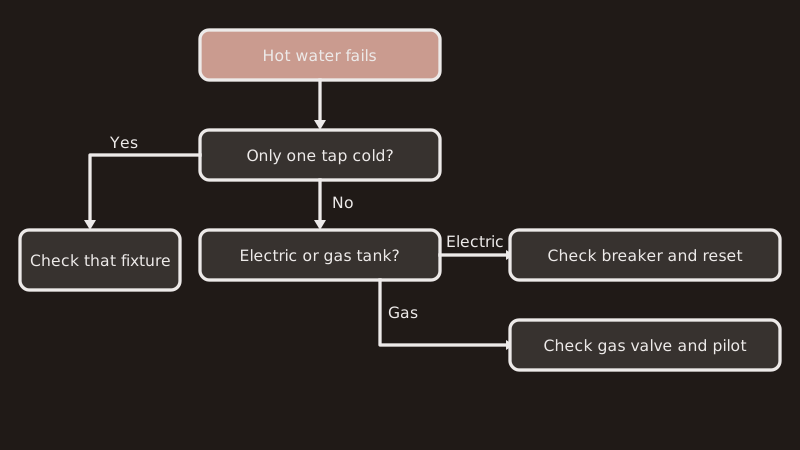
Start with the explanations that cost nothing. On an electric tank, that means the breaker panel and then the red reset button. On a gas tank, check that the flame is burning and the control is set to on. A single cold faucet beside hot ones clears the heater and blames the fixture. Anything beyond these checks goes to a water heater repair plumber, who is requested through the quote form. Other work we arrange is on the home page.
Is every hot tap cold, or only one?
Run the hot side at each tap in turn. When only one outlet goes cold, the culprit is local: a worn cartridge, a blocked aerator or a shower valve that has worn out. If the whole house stays cold or tepid, focus on the heater and the pipes feeding it, using the checks that follow.
How the hot water fails tells you something. Hot water that runs out within minutes hints at a burnt element, a snapped dip tube, or a thermostat dialed low. Water that never warms suggests the heat source is dead. Lukewarm and feeble suggests scale, or a shutoff that is only half open.
If anyone has worked on the plumbing lately, look at the valves on the heater's supply side. An inlet or outlet valve left half shut is a surprisingly frequent cause.
What should I try first on an electric tank?
Walk to the electrical panel first. Reset a tripped double-pole breaker by shoving it fully off and then back on. With the tank's power off, lift the upper access cover and press the high-limit thermostat's red button. No heat afterward points to a failed element or thermostat, and testing either is a plumber's task.
Kill the breaker before removing any cover, since live wiring is dangerous, and leave meter testing to someone trained. Unsure? Stop at the breaker.
A weak element shows as slow heating, quick run-outs, or a breaker that kicks off again straight after resetting. That second trip is a warning, so stop flipping the switch.
Certain Rheem models carry a status light, and the owner's manual translates the blink pattern. The model number to search for is printed on the tank's rating plate.
What do I look at on a gas tank?
Make sure the gas valve beside the heater is open and the control is turned on. Check the small viewing window for a pilot flame, and if it is dark, relight it by the steps on the tank's label. A whiff of gas stops everything: step outdoors, call SoCalGas on 1-800-427-2200, and 911 if you cannot reach them.
When a pilot refuses to stay lit, the cause is often a tired thermocouple, a draft, or a dirty pilot tube. The thermocouple is a small part, yet gas piping is contractor work. Most homeowners can relight by the label, but repeated outages call for a plumber.
Newer heaters use an electronic igniter in place of a standing pilot and signal faults with a light, with the codes listed in the manual. A blocked air intake, a tired flame sensor or a bad control board can each lock the unit out.
Why does the tank rumble and pop?
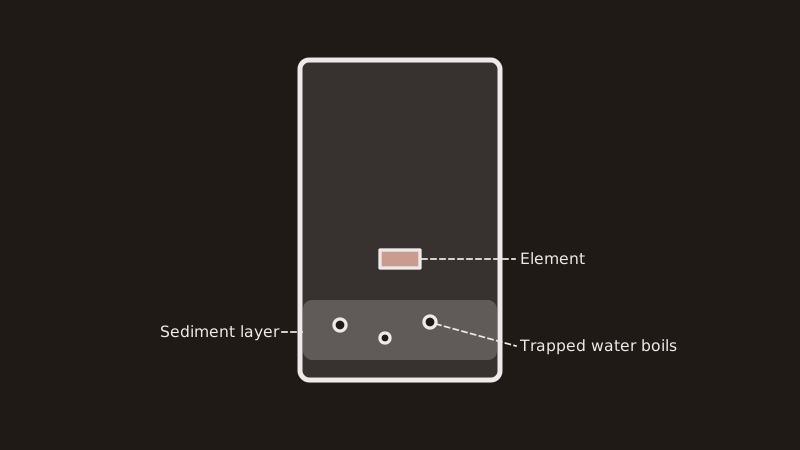
Popping, rumbling or crackling normally signals sediment lying on the tank floor, with water boiling under a mineral layer and breaking through it. The 2024 report from the San Bernardino Municipal Water Department gives a hardness average of 242.67 mg/L, about 14.2 grains per gallon, and harder water builds more of that crust. A flush can help, though a heavily caked old tank may not recover.
A thin whine may come from a half-shut valve, or an element that has come loose, and ticking after heating is often pipes expanding. A loud bang, or hissing with puddles around the tank, is worse: power or gas should go off, the cold supply should be closed, and a plumber should be called.
Noise often comes before total failure, because sediment smothers the element or burner and wears at the steel. The next section lists other early warnings.
How can I tell the heater is nearing the end?
Watch for slower heating, quicker run-outs, rusty or metallic-smelling water, new noises, dampness at the base, and a date sticker ten or more years old. Water on the floor matters most, since a tank with a hole in it cannot be patched and normally needs replacing.
Temperature swings and flakes of scale in the aerators count as early hints too. A leak and what it signals are covered in repairing a water heater leak, while the anode rod, which slows rust inside the tank, is described in anode rod replacement.
Better to replace on your own schedule than on a cold-shower morning, particularly with small children or an older relative at home.
Is going without hot water urgent?
Most of the time it is a nuisance. Call at once for gas odor, water pouring from the tank, scorch marks, or a breaker that cuts out again. Without those, the cold shower waits until morning. Water escaping from the tank is the cue to close the cold inlet at once.
If water is spreading, switch off the gas or power, shut the inlet and and open a hot tap to ease the pressure. Evening and weekend visits are covered at emergency water heater repair.
No hot water is a comfort problem; scalding water is a safety one. If the dial is set too high, bring it down toward the manufacturer's recommended setting on the label.
Who repairs it, and what price should I expect?
Hire a plumber who handles water heaters. Repair covers parts such as thermostats, elements, thermocouples and valves, while replacement is for tanks that have failed. This Old House puts water heater repair at $150-$750, and Bob Vila gives $874-$1,765 for replacement. The written quote holds the final figure.
An old tank that leaks or shows heavy corrosion is rarely worth repairing, whereas a younger unit with one failed part often is. Replacement has its own numbers at water heater replacement cost. Thinking about another type? Compare tank versus tankless.
In the offices we checked, a replacement is permit work. The City of San Bernardino says minor jobs such as water heater replacements are usually issued over the counter, at 909-998-2000. Redlands lists water heaters among its over-the-counter permits, at 909-798-7536. Parcels outside city limits deal with county Land Use Services at 909-387-8311.
Common questions
Why is the sink hot and the shower cold?
A single cold fixture points at the fixture. The shower mixing valve or cartridge may have failed, an aerator may be scaled over, or a pressure-balancing valve may be stuck. When every other tap runs hot, a plumber can replace that one part and leave the heater alone.
The heater quit right after the lights flickered. Why?
A power surge can trip an electric tank's breaker or its high-limit button. A gas model may need its pilot or electronic igniter restarted. Check the breaker, press the reset, and follow the lighting steps on the label if the flame went out. A second shutdown is a reason to call.
How quickly should a tank recover?
A standard tank can take an hour or longer to recover from a full draw, and gas is generally quicker than electric. If yours has become much slower than it used to be, suspect scale, a weak element or a tank that no longer fits the household's needs.
Do tankless units break down in different ways?
Yes. With no stored water, a tankless unit gives lukewarm output when scale coats the heat exchanger, the inlet screen clogs or the flow stays below the minimum. Many need periodic descaling in hard water, and the code on the display points to the cause.
References
- SoCalGas, natural gas leak safety
- San Bernardino Municipal Water Department, 2024 Consumer Confidence Report
- This Old House, plumber cost, checked 2026-11-17
- Bob Vila, water heater replacement cost, checked 2026-11-17
- City of San Bernardino Building and Safety Division
- City of Redlands Building and Safety Division
- San Bernardino County Land Use Services, plumbing permits