Fine spray, or blue-green crust, on a copper line? Close the valves upstream, drain the run and dry it off. Putty or a clamp will carry you through the night; cutting out the bad stretch and fitting fresh pipe is the part that lasts. For leaks of every size, the broader picture is in leaks and burst pipes. Would you rather pass this on? Begin with the quote form; the remaining services are on the home page.
What counts as a pinhole leak?
A tiny hole through copper tubing, often finer than a pencil tip, that either seeps or throws a hair-thin jet. Most start as pitting, corrosion that eats outward from inside the pipe. One pinhole often signals thin walls elsewhere along the same run, and that decides whether a spot repair is enough.
Clues include a damp patch on drywall, a hiss behind a cabinet, green stains on the tubing, a bill that rose for no reason, and a meter dial turning while everything is off. A small leak does its damage quietly behind finished surfaces.
Early copper turns up in homes from the 1950s and 1960s. Around Del Rosa, ZIP 92404 shows a Census median build year of 1963 and 5,936 houses from the 1950s. Age does not condemn pipe by itself, but a pinhole in a house that old is a reason to inspect the rest of the run.
How do I slow a pinhole down tonight?
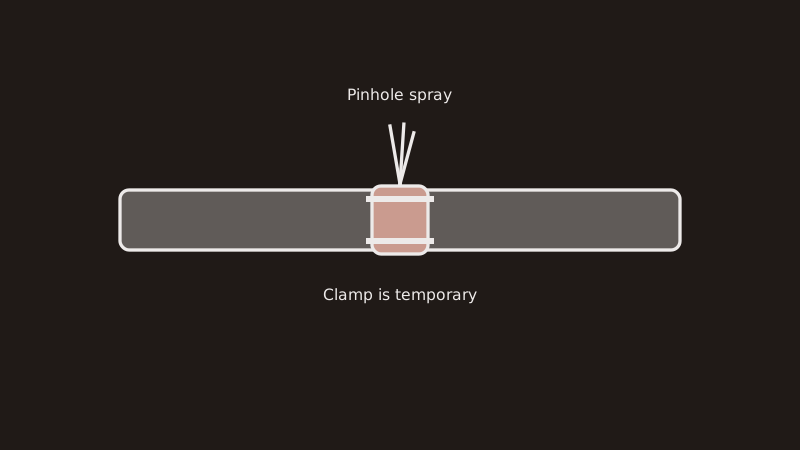
Close whichever stop valve is nearest (the main will do) and drain the line at a faucet farther along. Wipe the area dry. Now strap a square of rubber across the hole with a hose clamp, or mash two-part epoxy putty onto it and let it cure for as long as its label demands. Both are stopgaps, and the section should be replaced within days, not months.
What works, in order of strength:
- Rubber and clamp: a rubber strip, a steel clamp, a screwdriver. Tighten until the spray stops, stopping short of denting the tube.
- Putty or silicone repair tape: knead or stretch, press, hold. Needs a bone-dry surface and time to cure.
- Gasketed repair sleeve: a clamp built for the job, sold in sizes matching your tubing.
- Push-fit coupling: the one that crosses from emergency to permanent, covered below.
Nothing on that list belongs behind a finished wall for years. If reaching the pinhole means opening a wall, that is a plumber's job.
What is the lasting repair?
Remove the damaged stretch and bridge the gap with fresh copper or a push-fit coupling. Close the water and empty the line, make square cuts either side of the damage with a tubing cutter, ream the edges, and push a coupling on to its marked depth. Turn the supply back on gradually and look for drips. Soldering is the traditional route, though it demands a bone-dry pipe and fire precautions.

Push-fit couplings suit a beginner since no torch is involved. Prepare the tube end carefully: round, clean and scratch-free, because the coupling's grip depends on that surface.
Sweating a joint takes practice. Water left inside flashes to steam and keeps solder from flowing, and the flame can light framing or insulation behind the pipe. Near wood, use a flame shield or pick a fitting that needs no heat.
Several pinholes close together mean patching is chasing the problem. Repipe costs shows what replacement involves, and PEX versus copper handles the material question.
How would I know a wall pipe has let go?
Watch what the system does while nobody uses it. Signs to watch for: the meter creeping while every tap is off, a hiss or trickle inside the wall, warm or damp spots, a widening stain, bubbling paint, a stale smell, a water bill that rises without cause. A few of these together suggest a burst or pinhole.
The meter test is simple: shut everything off, note the dial, wait a few minutes, note it again. Delay costs money: the EPA says the typical household leak wastes more than 9,300 gallons a year.
Some plumbers bring thermal cameras or moisture meters that reveal wet drywall without demolition. Read how to know if a pipe burst for more symptoms. With water pouring, skip the detective work, shut the main and go to emergency burst pipe help.
My ceiling is soaked. What now?
Stop the source before anything else. If the ceiling bulges with trapped water, set a bucket beneath the lowest point and poke the sag with a screwdriver so it drains in one spot rather than collapsing. Then run fans and a dehumidifier for several days, open windows when weather allows, and pull out soaked insulation and drywall.
Leave lights and fans on a wet ceiling switched off. Water inside a fixture box is a shock risk, so trip that circuit's breaker. Take photos for an insurance claim before tearing anything out.
Drywall that stays damp for days invites mold, and sagging or stained panels usually need replacing instead of drying. Cut back to dry edges. Soaked insulation rarely recovers. When the framing is dry and the leak fixed, patch, apply stain-blocking primer and paint. The repair side continues at ceiling water leak.
And a burst pipe out in the yard?
A split in a yard line, hose bib feed or sprinkler pipe starts the same way: stop the supply. Start by closing the sprinkler valve or the house main. Dial 811 before breaking ground so buried utilities get marked, then clear soil from the pipe by hand, remove the broken piece and rejoin the ends with a coupling that suits the material.
Between meter and house runs the service line. Repairing it is contractor work and frequently needs a permit. San Bernardino's Building and Safety Division takes questions on 909-998-2000; other cities and the county run their own offices.
Water escaping before it reaches the meter is usually the supplier's to handle; the supplier is named on your bill. A soggy yard with no visible source calls for the meter test, which shows whether water is escaping underground.
Can a leaking PVC joint be repaired?
Yes, but not by adding glue to a wet joint. Cut the water, let the pipe drain and dry, then remove the weeping joint and rebuild it with a new fitting and short lengths of pipe, primed and solvent-cemented. A slip repair coupling lets you do this without moving the pipe ends.
The sequence runs: square cut, deburr, dry-fit, prime, cement, then hold the joint for around thirty seconds. The cement can's label gives the wait before pressure returns, and skipping it is how most repairs leak a second time.
A threaded PVC joint that weeps may need only fresh thread tape, though overtightening can crack the fitting. Drain joints that drip are a separate case.
Which leaks are beyond a weekend job?
A weekend repair stops being realistic when the pipe is sealed in framing or cast under concrete, a second pinhole shows up, valves will not close, the ceiling sags or water touches electrical parts. A plumber then traces the leak, cuts out the section and replaces it. The written quote fixes the price, and whoever you hire needs a California contractor license.
The license requirement kicks in at $1,000 with materials, and permit jobs need it at any price. A clamp or short push-fit repair stays under it; bigger repairs may not.
Get the scope on paper: which pipe, how much of it, and who patches the wall. Keep photos and the invoice for the insurer.
Common questions
Does a pinhole get bigger with time?
Usually. Moving water wears the edges, and thin tubing nearby tends to fail next. A small jet can also be spraying inside a wall, out of sight. Take a pinhole as a warning about that whole run and schedule a proper repair soon.
Is epoxy or tape a permanent cure?
No. Both are temporary, and on a pressurized line they eventually let go. They can carry you through a night or weekend until a repair is arranged. The wall around a pinhole is thin, so a lasting fix removes that section.
How much time will the fix take?
Reachable line, water off: a push-fit fix is typically over within the hour. Drywall, ceilings and slabs add hours, and locating a hidden pinhole can take longer than the repair itself. A plumber can give you an estimate once the leak has been found.
Will insurance pay for this?
Your policy decides. Many insurers handle a sudden failure differently than a drip that went on for months. Read the policy or ask the agent, and save photos, bills and the plumber's invoice. What any given policy covers is not something we can tell you.