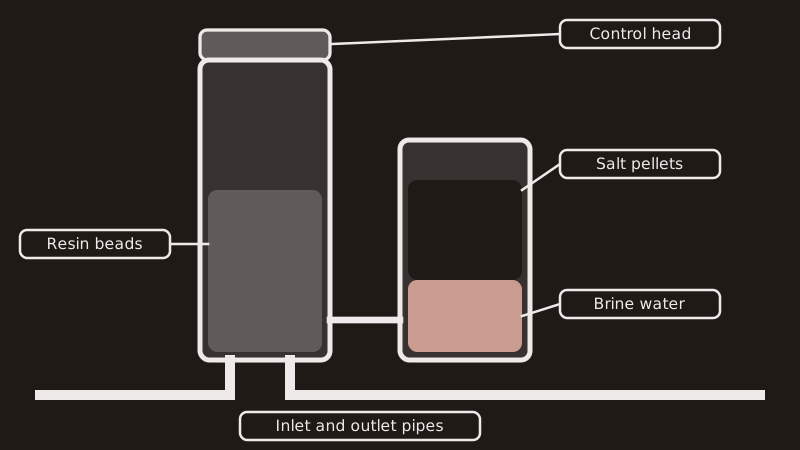
Install a softener at the point where water arrives in the building, and every fixture and appliance after it receives treated water: shower, heater, dishwasher, clothes washer, kitchen sink. Inside is a tank of resin beads. They trade the calcium and magnesium that build scale for sodium or potassium, then rinse themselves with brine. For the job in detail, open water softeners and treatment. Everything else we arrange is on the home page.
Coming up: placement, the work on the day, a reading of local hardness numbers, and the choices to make before purchase.
Do San Bernardino and Redlands taps run hard enough to need softening?
That depends on your supplier. The latest reports give these hardness readings. San Bernardino Municipal Water Department: 242.67 mg/L on average for 2024, within a range of 120 to 330. East Valley Water District, which covers Highland: 152 ppm for 2025. Redlands: 148 mg/L from groundwater and 117 from surface water. Yucaipa Valley Water District: 133.3 ppm, ranging from 92 to 290.
Our own conversion divides by 17.1. It gives about 14 grains per gallon for the city system, 8.9 for East Valley, 8.7 and 6.8 for Redlands, and 7.8 for Yucaipa. Each figure speaks for that supplier's customers only. Muscoy, Mentone, Crafton and Oak Glen may sit on other suppliers, so read the bill for a name. Softening is about comfort and upkeep. None of these reports treats it as a health measure.
Water near 14 grains leaves film on glassware, crust inside kettles and scale on heater elements. Around 7 or 8 grains the argument weakens, and some households pick a point-of-use filter instead.
At which point in the plumbing does a softener tie in?
It goes on the incoming main, after the shut-off valve and before the pipes that branch through the house. Usually the water heater comes after the unit, so hot water is softened as well. The hookup needs an inlet and outlet pair, a bypass valve, a brine drain and a nearby outlet, since the control head is electric.
It is common to keep one or two outside spigots on raw water, since soft water does lawns no good and can hurt some plants. The layout gets decided on the day, so request it by name if you want it.
Garage walls are a favorite location. In older bungalows around Redlands and Del Rosa, the main may instead be in a side yard, a crawlspace or a utility closet, which changes both the work and the bill.
What does the work on site look like?
First the water goes off and the main is opened up. A bypass is fitted, then the resin tank and brine unit are positioned. After that comes a drain line, power to the control head, your hardness setting and the opening regeneration cycle. Lines are flushed, and each joint is watched for seepage. Budget half a day, sometimes more, based on how easy the spot is to reach.
Trouble tends to hide in the surroundings. Old galvanized pipe at the connection point can crumble when cut, and brittle fittings may need replacing. If you think you have galvanized pipe, read galvanized pipe replacement first, because a softener cannot repair corroded lines.
A sequenced version appears in how softener installation works.
What space and utilities does a softener demand?
Set aside floor room for two tanks or one cabinet, a level base, a drain or standpipe close by, a power outlet and enough clearance to pour in salt. Most units take about the footprint of a water heater or less. A garage wall, utility room or covered side yard all work, provided the unit stays clear of freezing weather and direct sun.
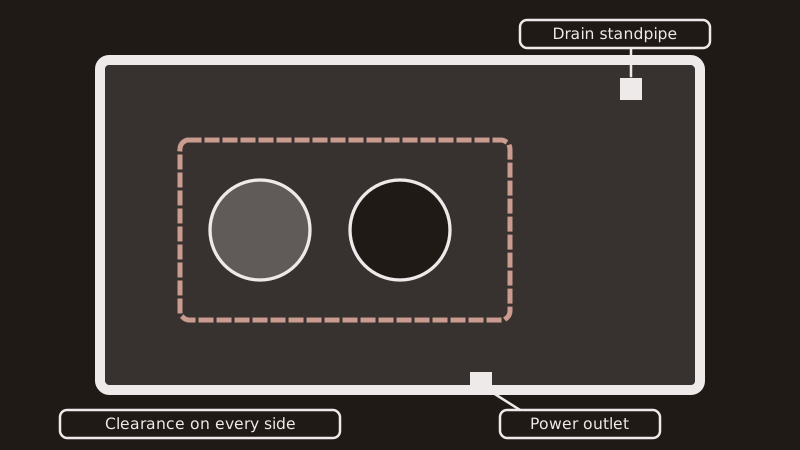
Salt-based models recharge with brine, and the discharge goes down a drain. A few California communities limit it. We found no rule confirmed for San Bernardino, Redlands, Highland or Yucaipa, so ask your water supplier or the city before committing.
Salt-free conditioners belong to another category. Rather than removing hardness, they alter how scale forms. Some homes do well with them, but the job is different, so compare what each product actually claims.
How big a softener do I need, and what numbers should I gather?
Capacity is counted in grains the resin holds between regenerations. Three inputs drive sizing: water hardness, how many people live in the house, and how many gallons they use each day. A big household on hard water needs a bigger unit, or one that regenerates more often and burns more salt.
Take the supplier's hardness figure to the plumber, along with the number of residents and bathrooms. Ask whether the unit regenerates on a timer or on demand, which affects salt and water use. A demand-controlled head usually suits a household whose usage swings.
Prices and what moves them are covered in our cost guide for water softener installation.
Is an installer license or a permit part of this?
Check with your building office. San Bernardino and Redlands each have a Building and Safety Division that issues plumbing permits by its own rules, and neither page we read mentions water softeners, so confirm for your address. California ties the contractor license rule to permits, and to jobs whose labor and materials total $1,000.
A contractor's standing can be verified on cslb.ca.gov. Anything over $500 needs a written contract. The board generally caps deposits at 10 percent of the price or $1,000, whichever is less; confirm with the CSLB.
When you are ready, tell us about your home, your supplier and your wishes using the quote page. A local plumbing business takes the request, pays us for the introduction and returns a written quote. Work waits for your approval.
Common questions
Does the visit last the whole day?
Often only half of one. Awkward access to the main, pipe that needs replacing or a drain that must be added can stretch it out. The quote should give an expected duration. Also ask about the water shutoff window, since service stops while the work is under way.
Should I tackle this myself on a Saturday?
A few owners try. Still, opening the main, building a drain and satisfying local rules are more than casual work, and a bad joint or a backed-up drain can flood the house. When a permit applies, the law sends the job to a contractor.
What maintenance comes afterward?
Keep salt in the brine tank, look at it every month or two, and break up any crust that forms. Clean the tank now and then and watch the head for error lights. If water feels hard again, the resin or the settings may need service.
Can a softener clean contaminants out of my drinking water?
No. A softener removes hardness minerals and is not a filter, so it does little for taste, chlorine or contaminants. Your supplier's quality report lists what is in the water. If something there worries you, a filter or a lab test is the next step.
References
- San Bernardino Municipal Water Department, 2024 water quality report
- East Valley Water District, 2025 water quality report
- City of Redlands, 2026 water quality report
- Yucaipa Valley Water District, annual water quality report
- City of San Bernardino, Building and Safety Division
- City of Redlands, Building and Safety Division
- California Contractors State License Board