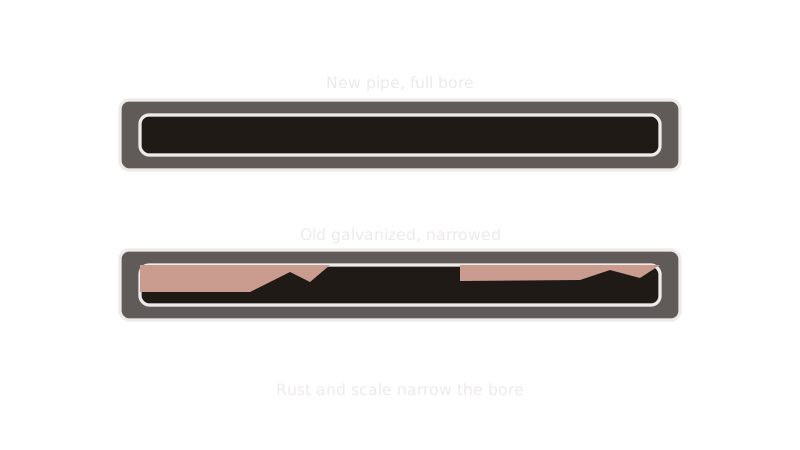
Look at where the weakness appears, since location shrinks the list. One lone dribbling tap suggests a blocked aerator or tired cartridge. Weak hot with healthy cold points toward the heater. If everything is sluggish at the same moment, think main valve, a failing regulator, a concealed leak, old pipe or a supply problem outside the property. For the repair side, see water pressure and valves. What follows is about tracking the cause down.
Is it one outlet or the whole building?
Open three or four taps in turn. A lone faucet or shower that stays weak while the rest run strong suggests a local blockage, like mineral crust in an aerator or showerhead, or a worn cartridge. When several fixtures drag together, the fault is deeper in the pipework.
Try hot and cold at the same tap. Only hot weak? Inspect the heater's shutoff, its connections and the sediment sitting in the tank. A good sink next to a poor bathtub puts suspicion on the tub's own valve or lines. Write down what is weak and at what time of day; the plumber saves time and you may spot the answer yourself.
How do I know it is beyond DIY?
Once several fixtures are affected and a closed valve and clogged aerator are off the list, once the water turns brown, or if the meter dial moves while every tap is off. That is when to book a plumber. Those clues suggest a regulator, a leak or old pipe, and each needs tools and sometimes a permit.
Fitting a regulator or a length of pipe is plumbing work with permit rules attached. Jobs at $1,000 in labor and materials, or any job a permit covers, are reserved for contractors holding a California license. Send a request that describes what you have seen. A local plumber then visits and gives you the price on paper first. A climbing bill is a related puzzle, covered under why the water bill is so high. The home page has everything else.
Is low water pressure dangerous?
Seldom by itself, though it can warn of something else: a hidden leak soaking a wall, corroded pipe near failure or an aging regulator. A trickle can also keep a tankless heater from igniting, so the shower runs cold. Most households notice the symptom long before the cause, and that delay is what makes it worth checking.
Excess pressure is the reverse problem, and it is the kind that breaks things. CPC 608.2 sets 80 psi as the top figure at fixtures, and a regulator holds it under that mark. Pressure that lurches between strong and weak often traces to the regulator. The regulator adjustment guide separates owner-safe steps from the ones to leave alone.
What if only the shower disappoints?
Sinks fine, shower poor? Suspect a clogged head, a flow restrictor, a worn cartridge or a sticky diverter. Take the head off and let it steep in vinegar, which often dissolves mineral scale, then check whether flow improves. A weak tub with everything else normal points to that tub's valve.
Scale is likelier in hard water, and numbers depend on the supplier: San Bernardino Municipal Water averaged 242.67 mg/L in 2024, while the City of Redlands reported 148 mg/L for groundwater in 2025. More shower-specific troubleshooting is in the shower leak guide.
Could the water supplier be the cause rather than my pipes?
Yes. If neighbors report the same weak flow, or it began after street work or a main repair, the cause may lie beyond your meter. Check the supplier's website or phone them. Your bill names who serves you, because service areas overlap in this region and a few small mutual companies exist.
San Bernardino Municipal Water lists (909) 384-5141 for water and sewer emergencies and (909) 384-5095 for customer service. East Valley Water District answers at (909) 889-9501, Redlands customer service is (909) 798-7516, and Yucaipa Valley Water District is (909) 797-5117. No verified local pressure figures exist for any neighborhood, so we cannot say what normal is on your street.
What would weaken every tap in the house?
Six usual suspects. A main shutoff left partly open. A regulator that has wandered off its setting. Scale or corrosion choking the pipes. A leak. A filter or softener gone clogged. A fault upstream of the meter. Each shows a different pattern, so line the symptom up with the cause before spending money.
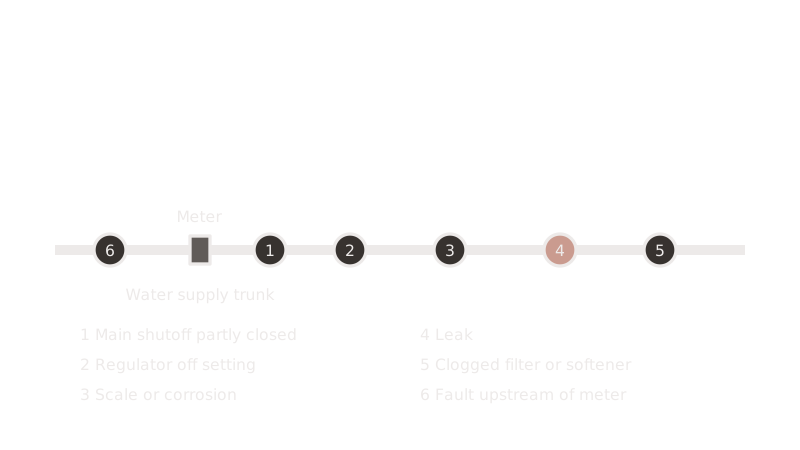
Opening a half-closed valve is free, so try that first and spin any gate-valve handle to its stop. Right at the service entry sits the regulator, which sets the pressure; when it fails, pressure can swing low or high. Leaks drain pressure too. The EPA reports more than 9,300 gallons a year lost per household. A clogged filter or softener starves the whole house until the cartridge or valve is cleaned.
Why would an older San Bernardino or Redlands house have weak pressure?
Age, mostly. In Census Reporter's data, ZIP 92404 (which takes in Del Rosa) shows 1963 as the median year a home was built, and 1,372 homes in Redlands ZIP 92373 date from before 1940. Homes of that vintage can contain galvanized steel, which rusts internally and closes in on itself a little every year.
Brown tinge after a few days away, flow that faded slowly and weakness at the farthest bathroom all fit. New pipe is the cure, whether a single run or everything. Read galvanized pipe replacement for the partial route and repiping for the whole house. Newer tracts may corrode less, so their problem can be more often a regulator or a valve.
Common questions
Will the cause be easy to find?
Sometimes. A shut valve or a clogged aerator shows itself in minutes. A concealed leak or a rotted line takes longer, since testing, listening and occasionally opening a wall are involved. The estimate follows the inspection rather than preceding it.
Which questions are worth asking?
Whether pressure gets measured with a gauge before any part is replaced, and what the written quote covers. If a regulator or new piping is proposed, ask what evidence supports it. Thread an inexpensive gauge onto a garden spigot and you have a first reading.
Should somebody be there?
Yes, an adult has to unlock access to the main valve, regulator, water heater and the fixtures in question. Watching every move is optional. Mention locked gates, pets and cramped crawl spaces in your request, so the trip is not wasted.
Can weak pressure damage appliances?
It can make a dishwasher or washer slow to fill and keep a tankless heater from lighting. Real damage usually comes from whatever causes the weakness, such as a leak, not the weakness itself. Keep an eye on your meter and monthly bill.
Is a booster pump worth considering?
Occasionally, where supply is steady but just weak. A pump does nothing for a leak, a shut valve or a clogged pipe, so find the cause first, and have the plumber explain why a pump suits your house before one goes in.
References
- San Bernardino Municipal Water Department, customers page
- East Valley Water District
- City of Redlands, water and wastewater
- Yucaipa Valley Water District, contact
- US Census Reporter, housing by year built for ZIP 92404, 92373 and 92374
- EPA WaterSense, Fix a Leak Week
- California Contractors State License Board