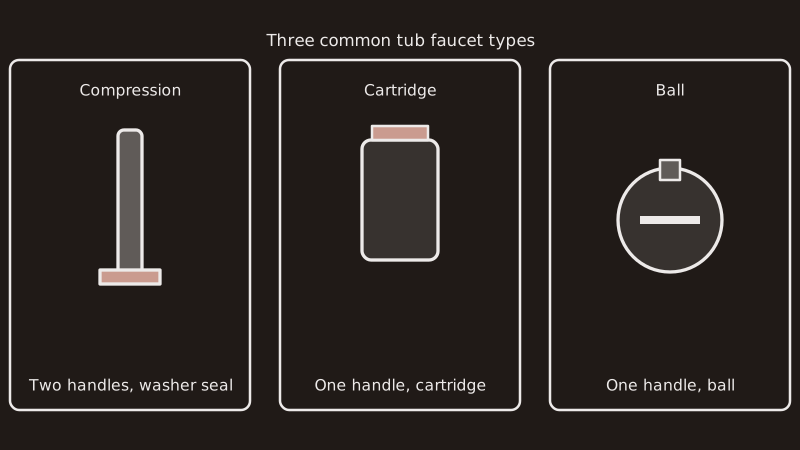
Nearly all spout drips come down to one tired component in the valve. Once you have shut the supply and removed the handle, you swap that component: a rubber washer for two-handle tubs, a cartridge for single-handle ones. Rebuild the valve and let water return slowly. Should corrosion have fused the handle, or the valve body show pitting, bring in a plumber. Neighboring fixtures, such as faucets, sinks, showers and disposals, are covered on a page of their own, while the home page lists everything.
Is my tub faucet a washer type or a cartridge type?
Look at the handles. Two usually signal compression stems or paired cartridges; one signals a single cartridge, or on a very old fixture a ball assembly. The replacement you buy hinges on this, so decide before touching a screw, and photograph each stage.
Some quick giveaways:
- Controls that stiffen the further you crank them shut hold compression stems and rubber washers.
- A lever that rotates to set temperature and draws outward to set flow is nearly always a cartridge.
- Water at the spout with every control closed implicates the stems or cartridge. A damp patch under the handle suggests the O-ring or packing nut instead.
A shower head that keeps running after shutoff is a separate issue, handled in shower leak plumber. Drips at other fixtures are covered by the leaky faucet fix guide.
How do I take out the old part and put in a new one?
Set out screwdrivers, an adjustable wrench, pliers, a rag and a matching replacement part. Water off, drain covered: now you work from the outside inward. Cap first, then screw, handle and trim plate, and last the stem or cartridge, which you set beside its replacement.
Follow this order:
- Hunt for stop valves behind an access panel. If none exist, close the main for the entire house, then open the tap until it runs out.
- Stuff the drain with a rag, because tiny screws disappear fast.
- Work the cap loose with a thin blade, undo the screw beneath, and take the handle off.
- Remove the trim plate followed by the bonnet nut or clip.
- Pull straight outward on the stem or cartridge, remembering how its markings were oriented.
- On compression stems, put in a new washer and retaining screw. Check the brass seat in the wall; if it is scored, resurface or replace it.
- Work backward through the same steps and let the water return a little at a time.
This one exchange ends most tub drips. If the old washer is squashed flat or cracked, you have your answer. A photo of the stem before removal helps at reassembly, and the hardware store clerk can match the part when you hold the old one up.
Why does my Moen bathroom faucet drip, and how do I stop it?
A tired cartridge or a hardened O-ring is the usual reason a single-handle Moen drips. Remove the handle, undo whatever retains the cartridge, draw it out, and seat the same model facing the same way. Moen sells many cartridge designs, so show the store the worn one.
A cartridge that will not release responds to a puller tool; mineral scale often glues it in place. San Bernardino Municipal Water Department reported average hardness of 242.67 mg/L in 2024, while the City of Redlands reported 148 mg/L for groundwater and 117 mg/L for surface water in its 2026 report. Hard water coats cartridges and valve seats with crust. Check your bill for the supplier that serves your street, because each figure speaks only for its own customers. Light deposits often dissolve in a vinegar soak, so try that before buying parts.
A bathroom sink faucet follows the same routine, though its shut-offs hide beneath the basin instead of inside a wall.
What does hiring a plumber for a faucet fix cost?
This Old House puts faucet replacement at $150 to $600 across the country, and Bob Vila quotes $161 to $364 to install a kitchen faucet. Swapping just a cartridge costs less than replacing the whole fixture. Treat both as nationwide guides. Your own fixture gets priced in the written quote, and nothing else sets the figure. Faucet installation prices goes further.
The EPA figure is worth remembering: more than 9,300 gallons of water a year go to a typical household leak, so even a small drip matters. Have the part spelled out on the quote, and labor kept separate from the trip charge. On a fixture that is old and pitted, replacing it may beat repairing it, and the plumber can quote either route.
Reach out when shut-offs will not turn, the handle has seized, the wall around the spout is soaked, or two repairs have failed. Describe the job on the quote page and we will arrange a visit.
A pipe is leaking under my kitchen sink. Where do I start?
Locate the wet spot before anything else. Dry each joint, turn on the tap, and dab a paper towel on every connection one by one. A slip nut on the trap that weeps needs tightening or a new washer. A damp supply line is replaced. Moisture at the basket or disposal means the seal there must be remade.
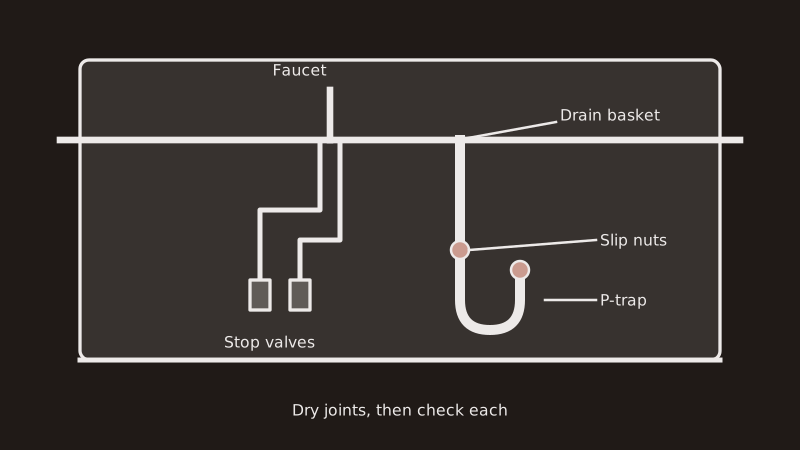
Check the cabinet in this sequence:
- Trap slip nuts: snug them with your fingers, then give pliers one-quarter turn at most, and go gentler still on plastic.
- Braided supply hoses and both end nuts: any hose that is wet, bent or white with crust gets replaced.
- The faucet base and spray hose, which drip down the sink's underside.
- The strainer basket: lift it out, scrape off the dried putty, bed it in fresh plumber's putty and tighten.
- The disposal's flange, seams and drain hose, because a unit that hums, jams or rocks may be leaking where it mounts.
A split disposal housing means buying a new unit; garbage disposal repair explains. Seepage out of the cabinet's back wall, or a drain still damp after every washer is renewed, calls for a visit. When the source stays hidden, plumber for leaks can help.
Common questions
How much time should I allow?
A handy person needs under an hour for a washer or cartridge exchange, and a plumber typically finishes during one visit. Frozen parts, hidden shut-offs and corroded stems stretch the time. A drip under the sink goes quickly with a bad washer, though a re-sealed drain basket takes longer.
What questions help before I book a faucet repair?
Ask for the part cost and labor itemized in writing. Learn what the trip charge covers, whether the total moves if a valve seat or stop valve is found bad, and who buys a new faucet if that becomes necessary. The state lookup at cslb.ca.gov will confirm it.
Do I need to be around while the work is done?
Yes, somebody does. An adult should be at the property to admit the plumber, show which fixture leaks and sign off on quote changes. Hovering is not required. Clear the cabinet or tub surround ahead of time, and mention pets or cramped access.
Should I fix it myself or call someone?
Proceed alone if the shut-off closes, the handle comes off easily and the part is visible. Make the call if water will not stop, the valve is buried behind solid wall, or your attempt left the drip in place. A second try on a worn valve can scar the metal, so stopping early is reasonable. Keep the shut-off closed, note what you already removed, and send that along with your request.